
Short answer first:
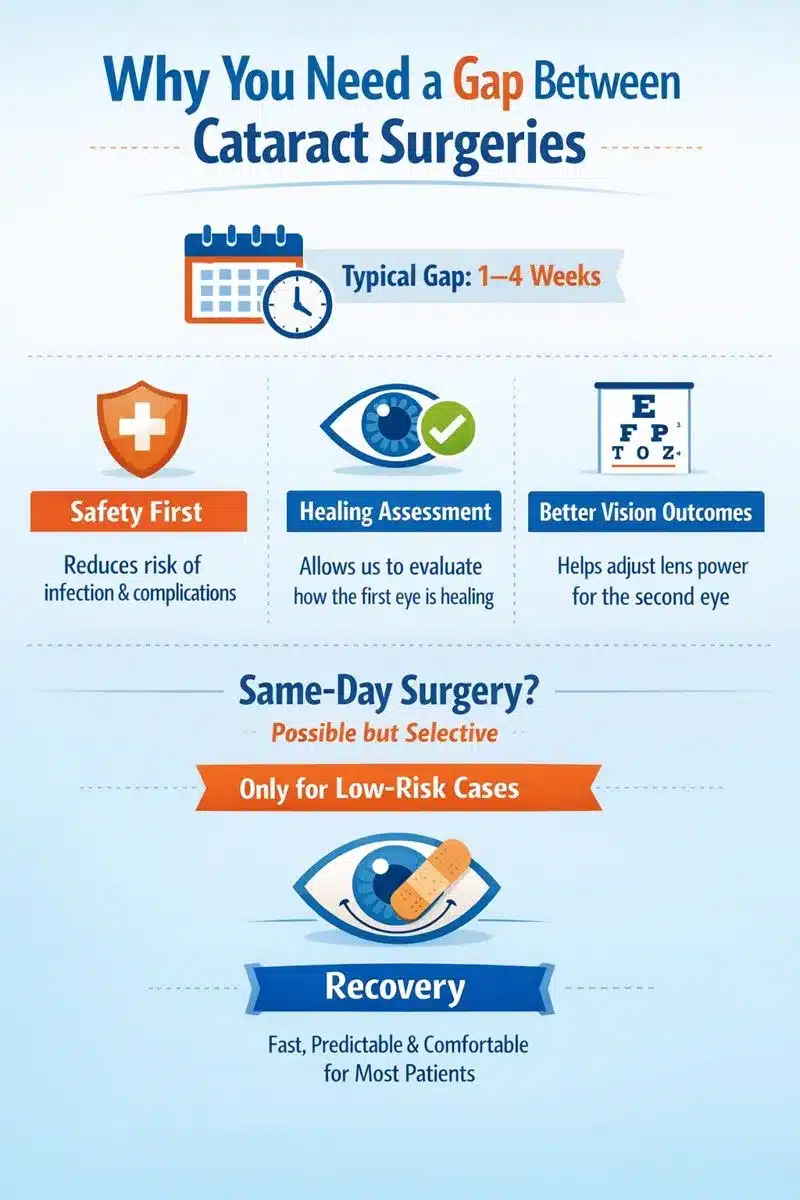
Most patients should wait 1-2 weeks between cataract surgeries in each eye.
Not because surgeons want to delay you, but because this gap protects your vision and improves final results.
This is one of the most common questions I hear.
And it’s a fair one.
You want:
From a patient’s perspective, one-stage surgery feels efficient.
From a surgeon’s point of view, vision safety comes first.
The decision is not emotional. It is clinical. As a cataract surgeon in Navi Mumbai, this is what I usually advise my patients.
For most patients, I recommend:
7 days between eyes
Why this range?
Because the first eye gives us critical information that helps us treat the second eye better.
This is not guesswork. It is an evidence-based practice used worldwide.
If you are looking for cataract surgery in Navi Mumbai at Suruchi Eye Hospital, I prefer a time gap between surgeries. There are reasons for it.
Every eye responds a little differently.
After the first surgery, we observe:
Even when surgery is technically perfect, biology can vary.
Operating the second eye after seeing the first eye’s response reduces surprises.
This point matters more than most patients realise.
Cataract surgery is also refractive surgery.
We are choosing an artificial lens that decides your final vision.
If the first eye heals slightly differently than predicted, we can:
This improves long-term satisfaction, especially for people choosing premium lenses.
Severe infection after cataract surgery is uncommon. But if it happens, it can be devastating.
By spacing surgeries:
Global ophthalmology bodies, such as the American Academy of Ophthalmology and the Royal College of Ophthalmologists, strongly support this approach.
Vision is not just about eyes. It is about the brain.
After the first surgery:
This adaptation helps the second eye integrate more smoothly.
Yes, same-day bilateral cataract surgery does exist.
But it is not routine.
I consider it only when all of the following are true:
Even then, both eyes are treated as two completely separate surgeries, with new instruments and setups.
This approach is more common in select international centres and among specific patient populations. It is not the default for a reason.
Patients often hear the convenience side. They rarely hear the downsides.
Here they are, clearly.
Rare does not mean impossible.
No surgeon wants to manage inflammation or infection in both eyes at once.
You lose the opportunity to:
For patients wanting sharp, balanced vision, this matters.
When both eyes heal together:
Many patients underestimate this.
Let me be very clear here.
This is not about:
It is about risk management.
The first eye is both:
Once we see that result, the second surgery becomes safer and more precise.
This is why the staged approach remains the global standard.
By the time the second eye is done, patients usually feel far more confident.
This is important to address honestly.
Cataract surgery today is:
You are not “experiencing pain twice”.
You are simply allowing your eyes to heal safely, one at a time.
If you ask me, “Doctor, what would you recommend for your own family?”
My answer is consistent.
Operate one eye first. Let it heal. Then operate the second.
Exceptions exist.
But standards exist for a reason.
At Suruchi Eye Hospital, my goal is not speed.
My goal is a clear, stable, lifelong vision.
If you want convenience alone, same-day surgery may sound attractive.
If you want safety, precision, and peace of mind, staged surgery usually wins.
The best decision is not the fastest one.
It is the one that protects your eyesight for decades.