
If you have been told you need cataract surgery, confusion is normal.
Patients often ask me the same questions.
Which cataract surgery is best?
Is laser cataract surgery better?
Will the surgery be painful?
How soon will vision improve?
I am Dr. Rajesh Kapoor, and at Suruchi Eye Hospital & Lasik Centre, my role is not only to perform surgery.
My role is to help you understand what is happening inside your eye and why one cataract surgery technique may suit you better than another.
Let me explain the commonly used cataract surgery options in clear, simple terms.
Inside your eye is a natural, clear lens.
With age, diabetes, injury, or long-term sun exposure, this lens slowly becomes cloudy.
This clouding is called a cataract.
Eye drops, medicines, or glasses cannot remove a cataract.
Cataract surgery is the only permanent treatment.
The reassuring part is this.
Modern cataract surgery is safe, predictable, and highly successful.
Phacoemulsification is the most commonly performed cataract surgery today.
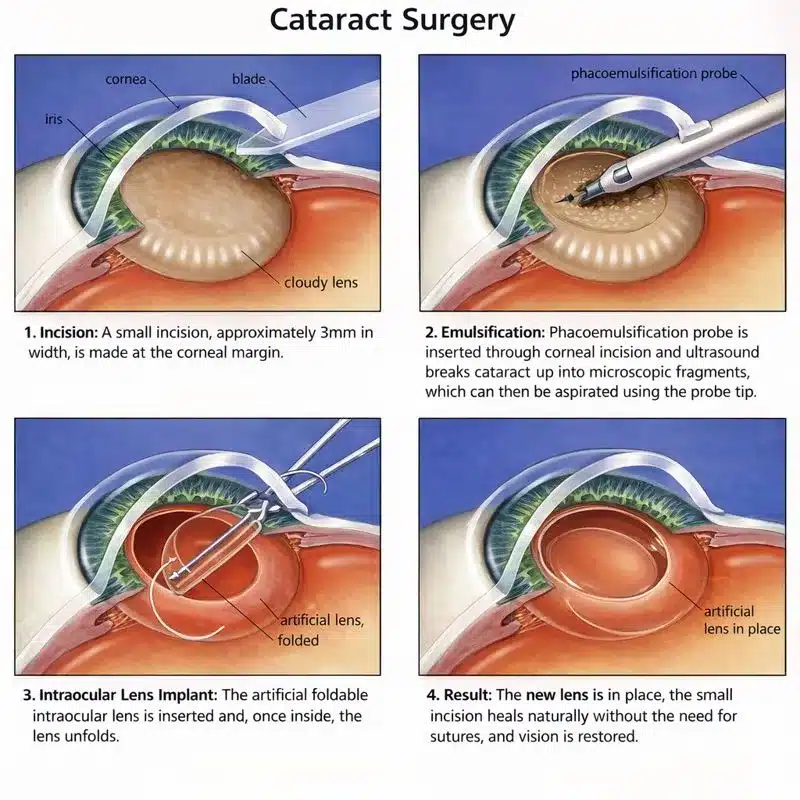
A very small incision, usually 2.2 to 2.8 mm, is made.
An ultrasound probe breaks the cloudy lens into tiny fragments.
These fragments are removed, and an artificial intraocular lens is placed.
In most cases, stitches are not required.
At Suruchi Eye Hospital, phaco surgery is our preferred technique whenever the cataract density and eye condition allow it.
Small Incision Cataract Surgery, or SICS, is a proven and dependable technique.
A self-sealing incision, slightly larger than phaco, is created.
The cataract is removed manually in one piece.
An artificial lens is placed inside the eye.
SICS is not inferior surgery.
When chosen correctly, it delivers excellent results.
In some cases, the cataract is extremely hard or long-standing.
When phaco or SICS is not the safest option, extracapsular cataract extraction is considered.
A larger incision, around 9 to 10 mm, is made.
The cataract is removed in one piece.
The posterior lens support is preserved for the placement of an artificial lens.
Stitches are usually required.
ECCE is selective, not outdated.
Used appropriately, it protects the eye.
Cataract surgery continues to evolve.
At Suruchi Eye Hospital, we focus on techniques that reduce surgical trauma and improve recovery quality.
Zepto-assisted cataract surgery uses a Zepto probe for selected steps of the procedure.
The Zepto helps to:
Zepto is used along with phaco, not as a replacement.
Zepto enhances surgical accuracy.
It does not replace surgical judgment.
This is an advanced form of phaco.
The incision is even smaller, often under 2.2 mm.
Most patients are surprised by how normal their eyes feel within days.
With a smaller incision, the cornea is disturbed less during surgery. This helps maintain the natural shape and strength of the eye, which plays a key role in how quickly vision stabilises after the procedure.
Because the wound is very small, it usually seals on its own. In most cases, stitches are not required. This reduces post-surgery irritation and lowers the chances of stitch-related discomfort or redness.
A smaller incision also improves wound stability in the early healing phase. This is important in reducing fluid leakage and minimising the risk of infection during the first few days after surgery.
Patients often experience less redness, minimal watering, and very mild discomfort compared to larger-incision techniques. Many are able to resume routine indoor activities within a short period, as advised by the doctor.
Micro-incision surgery also helps reduce post-operative corneal swelling. Less swelling means clearer vision earlier and fewer visual fluctuations during recovery.
This technique is especially useful for patients who value faster functional recovery, post-surgical comfort, and minimal disruption to daily life. However, it is always chosen based on cataract density and overall eye health, with safety as the top priority.
There is no single best cataract surgery for every patient.
I consider:
Some patients prioritise faster recovery.
Others need maximum safety.
Some require advanced lens correction.
The goal is always to match the technique to the eye.
Cataract surgery is usually painless.
After surgery, you may notice:
Vision improves steadily over days to weeks.
Eye drops and follow-up visits are important.
Patients undergoing phaco or micro-incision surgery usually resume routine activities quickly.
Cataract surgery is not something to fear.
It is something to understand.
When you understand your options, you feel confident.
When you feel confident, recovery is smoother.
At Suruchi Eye Hospital, we focus on:
If you are experiencing cataract symptoms, a proper eye evaluation is the first step.
An informed decision always leads to better outcomes.