
When someone walks into my clinic and says,
“Doctor, I had LASIK years ago. My number seems to be back. Can LASIK be done twice?”
I can hear the worry behind the question.
Sometimes it is a mild blur while driving at night.
Sometimes it is a dependence on glasses again after many years of freedom.
Sometimes, it feels like the clarity was never fully satisfying.
The short answer is this:
Yes, in selected cases, LASIK can be repeated.
But not everyone should do it.
The more important word here is evaluation.
There is no preset numerical limit for LASIK. However, each procedure removes corneal tissue. The real deciding factor is whether your cornea remains structurally strong and stable enough to tolerate further treatment safely.
If your vision has changed, the first step is not planning another surgery.
The first step is understanding why it changed.
In my experience, these are the most common situations:
Each of these has a different solution.
And not all of them require another laser treatment.
This is where many people get confused.
If you are in your 20s or early 30s and the power has returned to a slight degree, it may be a mild regression of the cornea.
But if you are 40 or above and struggling with near vision, that is usually not regression.
That is presbyopia, a natural change in the lens of the eye.
LASIK reshapes the cornea.
Presbyopia happens because the internal lens loses flexibility.
Repeating corneal laser treatment will not correct a lens-based problem.
This distinction is critical.
Treating the wrong structure does not solve the real issue.
I do not base my decision solely on your old prescription.
I look at:
Even if the power has returned, the cornea must be structurally safe to treat again.
Repeat LASIK is not a cosmetic touch-up.
It is a structural decision.
If the cornea is thin or shows early instability, I will advise against it.
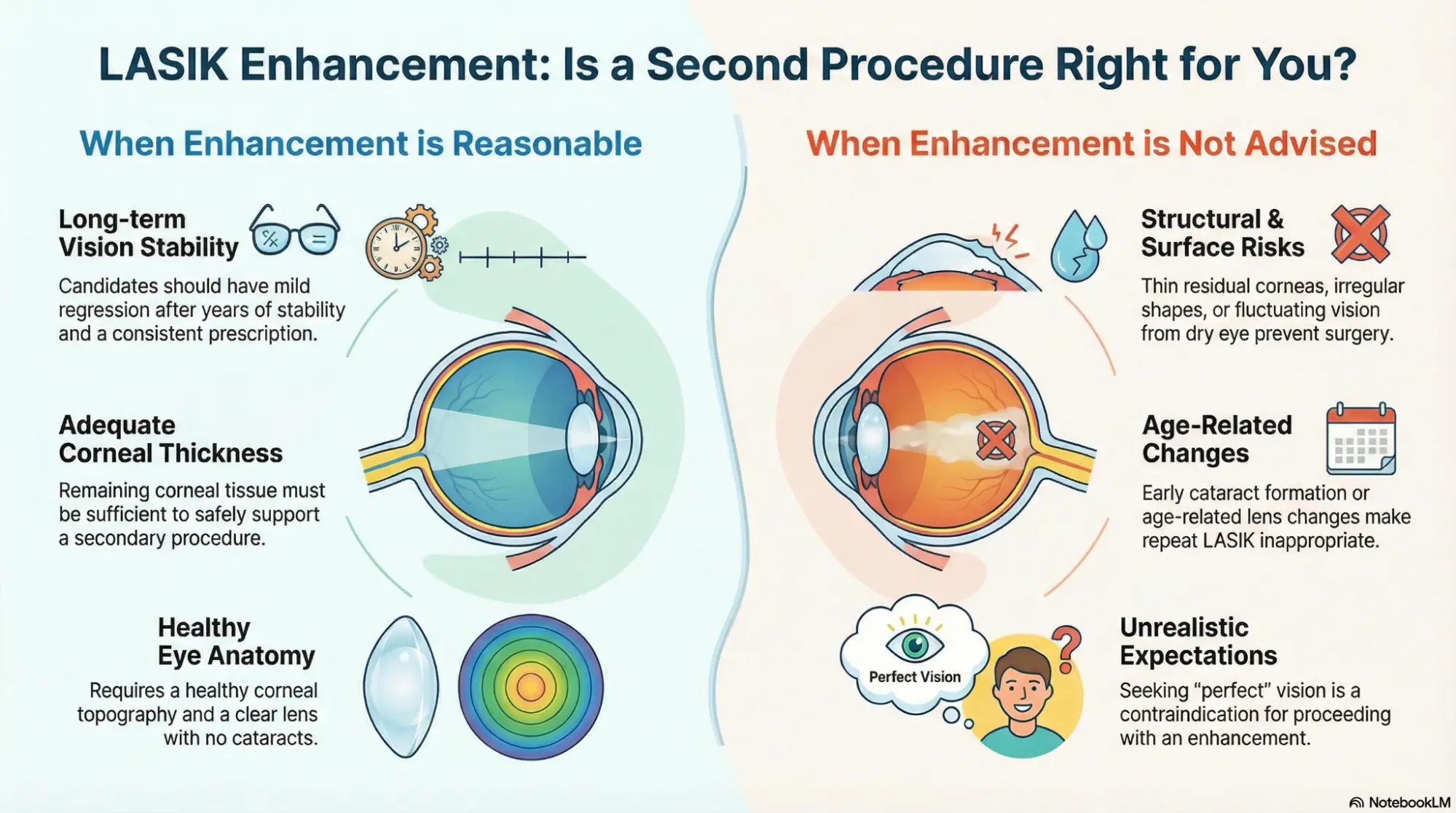
In selected cases, enhancement can be reasonable:
Even then, the decision depends on careful mapping and discussion.
There is no automatic “yes.”
There are situations where repeating LASIK is not advisable:
Better alternatives in these cases:
In some patients over 45, a lens-based procedure in the future may make more sense than another corneal surgery.
In others, a simple pair of glasses for specific tasks may be the most sensible solution.
Surgery is not always the smartest answer.
Occasionally, patients feel their clarity was never fully sharp.
That does not automatically mean something was done incorrectly.
Healing varies.
Tear film affects clarity.
Higher-order aberrations can influence night vision.
The only way to decide whether enhancement helps is through a detailed assessment.
Neutral, objective evaluation matters more than assumptions.
If your cornea was borderline before the first procedure, repeating laser treatment may not be safe.
Removing more tissue reduces structural strength.
In such cases, I would rather protect your long-term eye health than chase small visual improvements.
Preserving corneal stability always comes first.
Many patients think their power has returned.
After testing, we find significant dry eye.
Dryness causes fluctuating blur.
It worsens at the end of the day.
It improves temporarily after blinking.
Treating dryness can restore clarity without any surgery.
This is why evaluation is more important than eligibility.
The honest answer is:
It depends.
It depends on corneal strength.
It depends on tissue availability.
It depends on your age.
It depends on whether the problem is corneal or lens-related.
It depends on stability.
Some patients are good candidates for LASIK surgery.
Some are better served with glasses.
Some should consider lens-based options later in life.
And some should avoid further surgery entirely.
Vision correction should reduce dependence on glasses.
It should not create long-term risk.
If a second procedure improves quality of life without compromising safety, we can consider it.
If it increases structural risk for marginal gain, it is not worth it.
A careful assessment protects you from unnecessary surgery.
And sometimes, the most responsible medical decision is restraint.
If your vision has changed after LASIK, the next step is not another laser session.
It is a thorough, individualised evaluation.
That conversation is where clarity really begins.