
Let me guess how you ended up here.
You had an eye check-up. The doctor examined your eyes, perhaps mentioned “Grade 2 cataract” or “early-stage cataract,” and then… didn’t explain much beyond that. You left with a follow-up date but no real clarity on what that grade actually means for you.
Now you’re wondering: Does this grading of cataract decide when I need surgery? Should I be worried? Can I wait safely, or am I already late?
I see this confusion every single day in my clinic. Patients come in clutching reports with grades written on them, treating those numbers like a countdown timer. Family members call asking, “Doctor, it says Grade 3, does that mean surgery is urgent?”
Here’s what I need you to understand first: cataract grading describes your lens, not your surgery timeline.
Let me show you why that distinction matters.
When I examine your eye and assign a grade, I’m making a visual estimate of how cloudy your lens has become. It’s not a measurement from a machine. It’s not universal across all doctors.
If three different doctors examine the same cataract, you might get three slightly different grades. One might call it “early immature,” another might say “Grade 2,” and a third might describe it as “mild nuclear sclerosis.”
Posts from the cataractsurgery
community on Reddit
This variability doesn’t mean anyone is wrong. It just means grading is a descriptive tool like saying someone is “tall” versus measuring their exact height.
But here’s what grading doesn’t tell me: how much your cataract is affecting your daily life.
And that’s the only thing that actually matters for surgery decisions.
I can see a Grade 3 cataract in someone who’s functioning perfectly, driving, reading, working without trouble. I can also see an “early” cataract in someone who’s struggling with glare every evening, avoiding night driving, and constantly adjusting lights just to read.
It comes down to how you use your vision.
A retired gentleman with a Grade 2 cataract barely notices it. He reads the newspaper in bright morning light, goes for walks, and watches TV. No complaints.
A woman of the same age and grade came to me frustrated. She works on a computer daily, drives in the evening, and the glare from headlights has become unbearable.
Same grade, completely different impact.
Your lifestyle, visual demands, and even your tolerance for blur or glare change everything. This is why I never make surgery decisions based on grade alone.
Patients often assume there’s a fixed threshold, like once you hit Grade 3, surgery becomes mandatory. That’s not how it works.
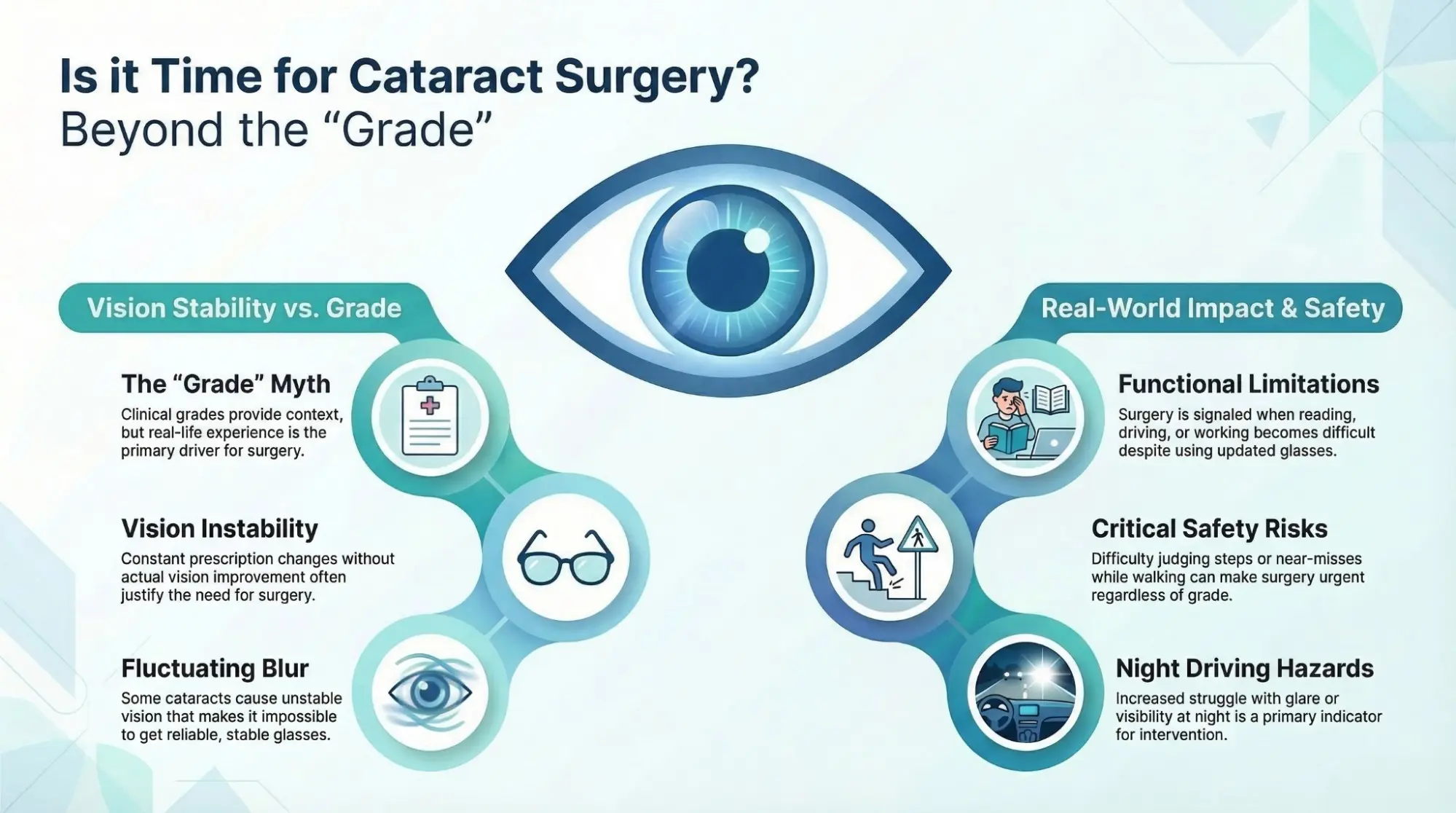
I look for three things:
Can you do what you need to do? If reading, driving, or working has become a struggle despite updated glasses, that’s a signal.
Are you at risk? Difficulty judging steps, trouble with night driving, or frequent near-misses while walking can make surgery urgent, even if the grade doesn’t sound “advanced.”
Is your prescription constantly changing without improvement? Some cataracts cause fluctuating blur that makes it impossible to get stable glasses. That alone can justify surgery, regardless of grade.
Grade is just context. What you’re experiencing in real life drives the decision.
You might have heard older relatives say, “Wait till the cataract is fully mature before operating.”
This was true decades ago when surgical techniques were different. But modern cataract surgery doesn’t work that way. We have the latest techniques like ZEPTO Robotic Cataract, which help us to achieve perfection at a very microscopic scale.
In fact, operating on an extremely mature, rock-hard cataract can sometimes be more complex than operating on a moderately developed one. The lens becomes tougher to break up.
Does that mean you should rush into surgery at the first sign of cataract? No.
It means there’s no benefit to delaying once the cataract starts affecting your quality of life.
The “right time” isn’t when the cataract is “ripe”, it’s when living with limited vision becomes harder than undergoing a routine procedure.
Waiting is reasonable if:
Waiting becomes risky if:
Notice I didn’t say “wait if you’re Grade 1 or 2” and “operate if you’re Grade 3 or 4.”
The decision isn’t dependent on the grading of cataract; it’s impact-driven.
Stop obsessing over the number. Start monitoring your functional vision.
Ask yourself:
These changes matter far more than whether your cataract went from Grade 2 to Grade 3.
When you come for follow-ups, tell me what’s different in your day-to-day life. That’s the conversation that helps me give you better advice.
Here’s a dynamic I see often: the patient is calm and managing fine, but a family member hears “Grade 3” and immediately assumes it’s urgent.
I understand the concern. But treating cataract grade like a crisis indicator creates unnecessary anxiety.
If your family is pushing for immediate surgery based on the grade alone:
Surgery is a decision you make with your doctor, based on your vision and lifestyle not based on someone else’s interpretation of a clinical term they found online.
The grade your doctor assigns helps track progression over time and provides a shared language between eye care professionals.
But it is not a surgery timer.
Surgery decisions are made by weighing how your vision affects your daily function, whether you’re safe and independent, and how stable your vision has become.
The number on your report is just one piece of a much larger picture.
If you’re unsettled because a grade was mentioned without explanation, I understand. But don’t let that number define your next steps. Let your real-world vision experience guide the conversation with your doctor.
You’re not late. You’re not in a crisis. You’re just trying to make sense of clinical language that wasn’t explained well enough.
Now you know what cataract grading really means and, more importantly, what it doesn’t.