
When someone searches for “cataract surgery recovery time,” it’s often not the patient. It’s a family member trying to plan the next few days.
Can they go back to work?
Will their parents manage alone?
How much help is really needed?
These are the questions we hear every day at Suruchi Eye Hospital. So here’s a clear, practical breakdown of what recovery actually looks like.
Cataract surgery recovery time doesn’t follow a fixed timeline.
Some improvements happen quickly. Others take time. And one important thing to understand is this: patients often feel better before the eye has fully healed.
This is where most families get confused. Either they relax too early or worry unnecessarily.
On the first day, most patients are comfortable. There is usually no significant pain.
However:
This is normal.
What matters on Day 1:
Even if they say they feel fine, supervision is necessary.
By the second or third day, patients often feel much more normal.
They may:
This creates a false sense of recovery.
The eye is still healing internally.
What’s okay:
What’s not okay:
Light supervision is still needed.
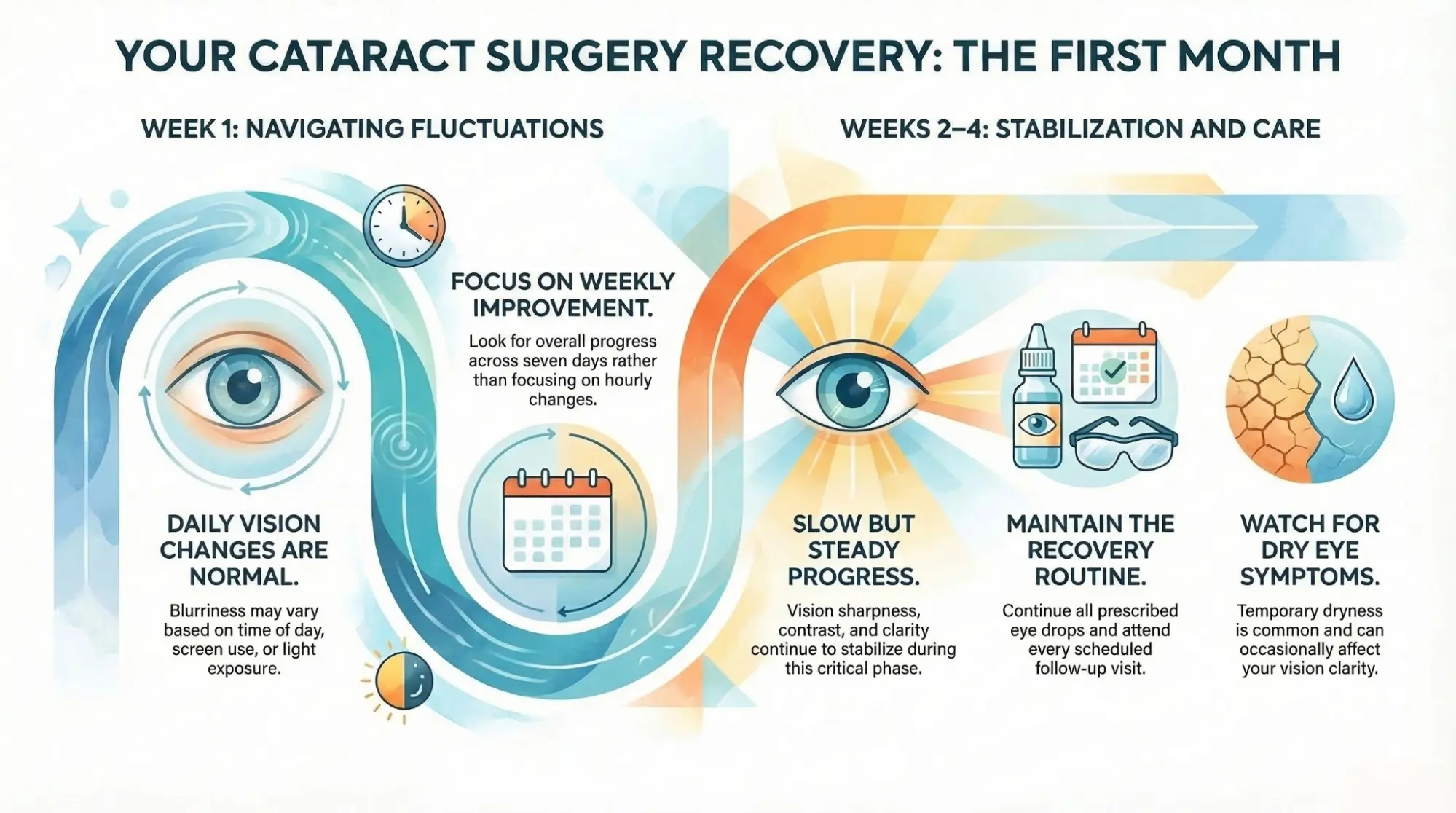
This phase often worries families.
You may hear things like these from the patient:
This is expected.
Vision can fluctuate due to:
Instead of focusing on daily changes, look at overall improvement across the week.
By this stage, many families expect full recovery. When vision is still not perfectly stable, they get concerned.
What’s actually happening:
This is a critical phase.
What matters most:
Recovery may feel slow, but this is normal.
Instead of relying on a fixed number of days, look for these signs:
Until then, some level of supervision is still advisable.
Many patients feel that the second Cataract eye surgery is harder, even though the procedure is the same.
The reason is simple:
This creates:
It can feel uncomfortable, but it settles with time.
“There’s no pain, so everything is fine.”
Some complications do not cause pain early on.
“Vision is clear; we can stop the drops.”
Eye drops control internal healing and inflammation. Stopping early can affect outcomes.
“Rest alone is enough.”
Recovery depends on proper medication, follow-ups, and care, not just rest.
Normal symptoms:
Seek medical attention if you notice:
Do not ignore these signs.
Once the patient feels better, follow-ups are often skipped. This is a mistake.
During these visits, doctors check:
These are not things the patient can assess at home.
Cataract surgery recovery is not just about “feeling normal.”
It is about:
With the right care, most patients recover smoothly. But the key is consistency with drops, follow-ups, and basic precautions.
If something feels unusual, don’t delay. Early attention prevents bigger problems.