
Can Cataract Surgery Be Done Twice? Here’s What You Need to Know
Table of Contents
“Doctor, meri cataract surgery dubara toh nahi hogi na?”
I hear this question almost every week in my clinic. And I completely understand the worry behind it. You’ve just gone through one surgery, your vision is finally clear, and the last thing you want is to hear that you might need it again.
So let me give you the honest, simple answer: No, a cataract cannot grow back.
But yes, sometimes people do need a second procedure.
Confused? Don’t worry – let me explain everything in the simplest way possible.
First, Let's Understand What Happens During Cataract Surgery
Think of your eye like a camera. Inside it, you have a natural lens that helps you focus and see clearly. When you have a cataract, that lens becomes foggy – like looking through a dirty windshield.
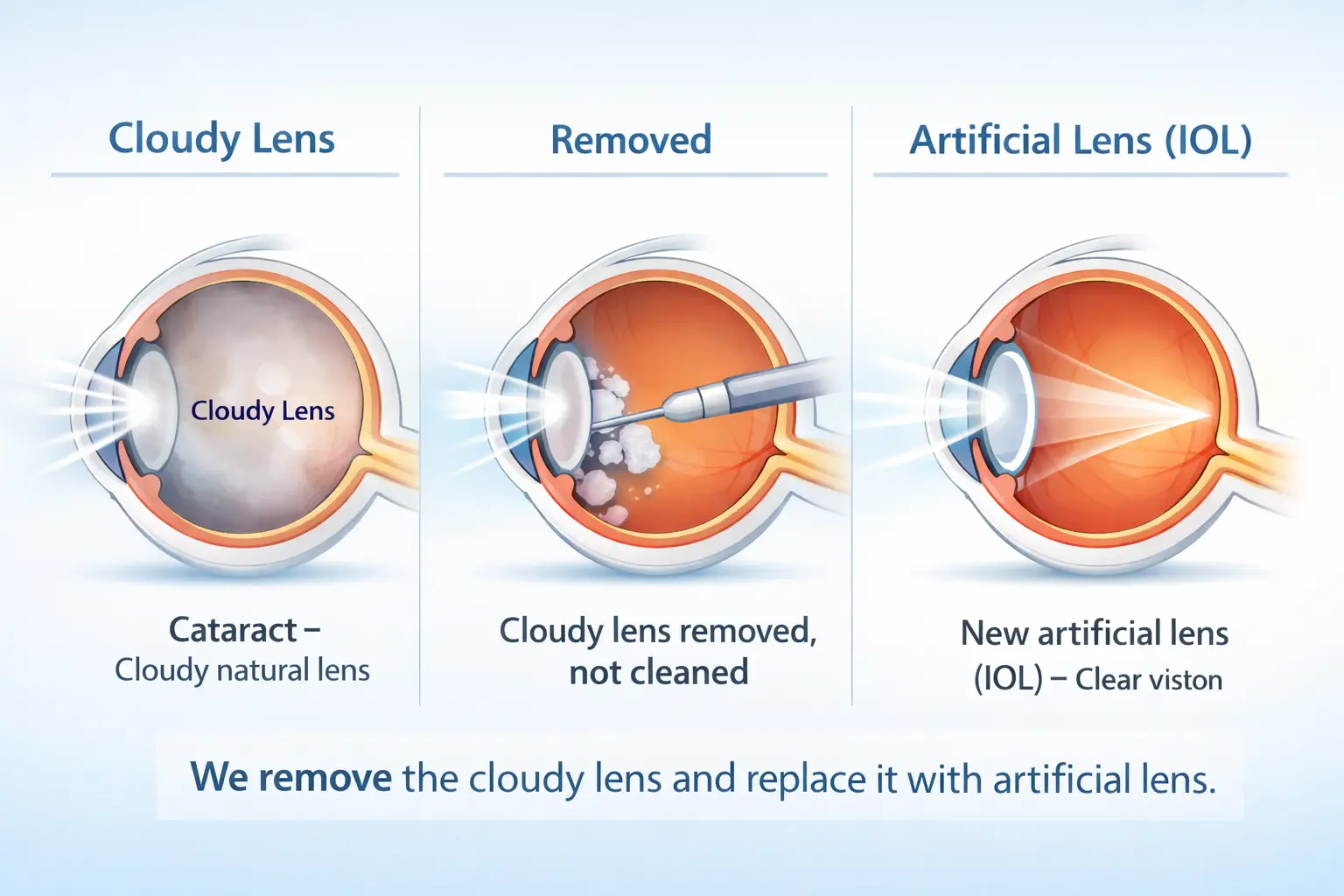
During cataract surgery, we don’t “clean” that foggy lens. We actually remove it completely and replace it with a brand new, crystal-clear artificial lens (we call it an IOL, or Intraocular Lens).
Because your original natural lens is gone forever, a cataract can never, ever grow back in that eye. It’s physically impossible.
So, Why Do Some People Say Their Cataract "Came Back"?
Here’s where it gets a little tricky. Sometimes patients come back to me saying, “Doctor, mujhe phir se dhundhla dikh raha hai. Kya cataract wapas aa gaya?”
The blurriness is real. But it’s not the cataract returning. It’s usually one of three things:
1. The "Dusty Window" Problem (The Most Common Reason)
Imagine this: We’ve put a beautiful new window (the artificial lens) in your eye. To hold it in place, we use a very thin, clear pocket that’s naturally part of your eye – like a tiny transparent bag.
Over time – could be months, could be years – some microscopic cells can start growing on the back of this pocket. These cells are leftovers from your original lens. They’re completely harmless, but they make the pocket cloudy, like dust settling on a window.
This is called PCO (Posterior Capsule Opacification), and it’s not your fault or ours. It’s just how some eyes heal naturally.
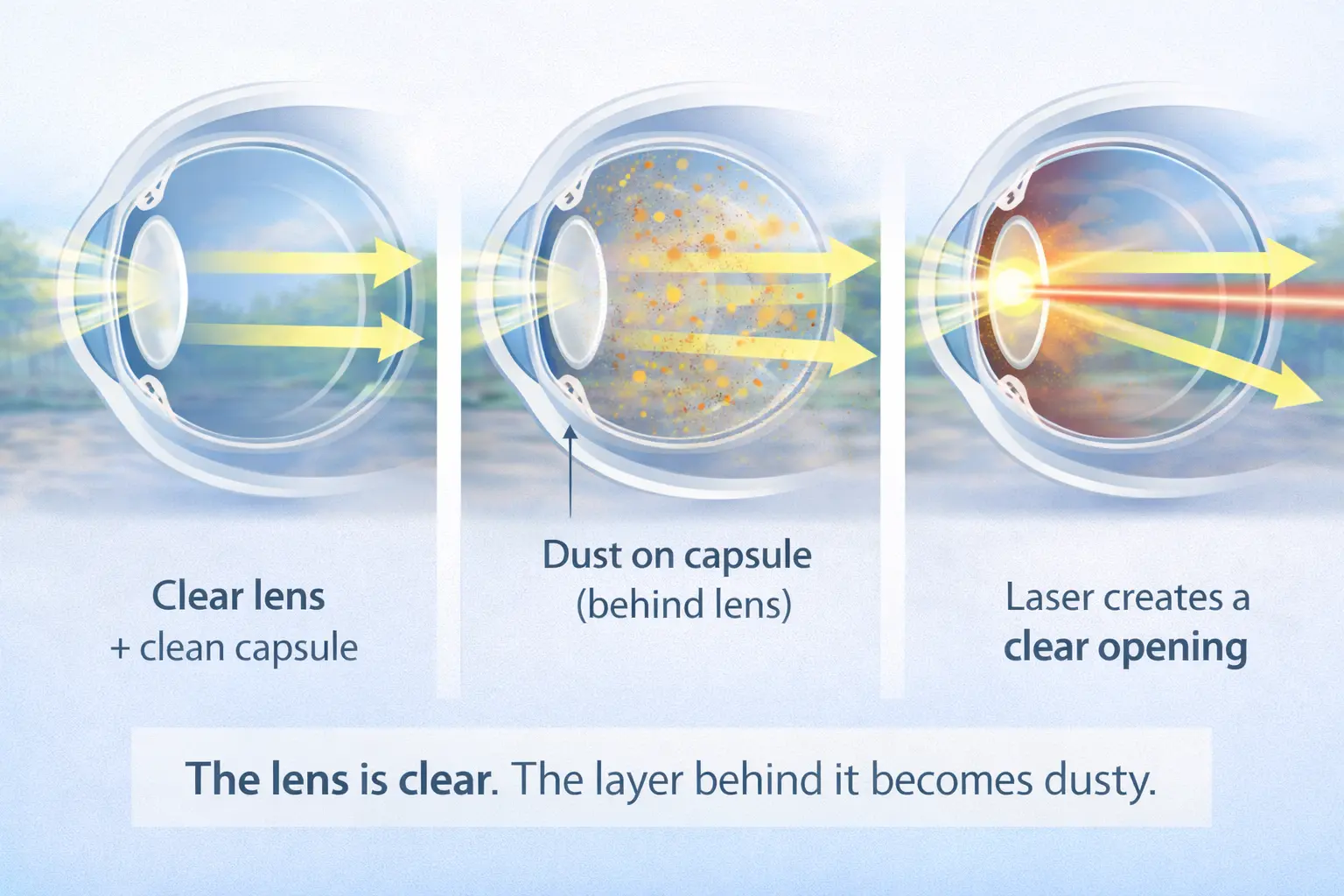
The Good News? We don’t need to do surgery again. There’s a quick, painless laser treatment called YAG laser capsulotomy.
You sit in a chair, we use a special laser to create a tiny opening in that dusty pocket, and boom – your vision is clear again in literally 5 minutes. No injections, no cutting, no recovery time. Most people only need this done once in their lifetime.
2. Swapping the Lens (IOL Exchange)
Very rarely – in about 3 out of 100 patients – the artificial lens itself needs to be replaced. This is called an IOL exchange.
Why might this happen?
The Power is Wrong: Just as with choosing the wrong number of reading glasses, sometimes the lens power isn’t perfect. Before surgery, we take very careful measurements of your eye, but every eye heals differently. Sometimes the lens settles in a slightly different position than we calculated, and your vision isn’t as sharp as it should be.
The Lens Moves: If you have an eye injury or if the tiny threads holding the lens in place are weak (which can happen with certain eye conditions), the lens can shift out of position.
Night Vision Issues: Some people opt for “premium” lenses that help with both near and far vision. These are great for many patients, but some people find they cause annoying glares or halos around lights at night – especially while driving. If these visual disturbances don’t settle down after a few months, we might recommend switching to a simpler lens.
Very Rare Material Issues: In extremely rare cases, the lens material itself can become cloudy or develop calcium deposits over time.
Now, replacing a lens is actual surgery – but it’s still safe. In fact, if it needs to be done, it’s usually easier within the first 3 months after your original surgery, before much healing tissue has formed.
3. Surgery on the Other Eye
This is probably the most common reason someone says they’re “having cataract surgery twice.”
Here’s the thing: cataracts usually develop in both eyes, not just one. But we rarely operate on both eyes on the same day.
Why?
Because we want to see how the first eye heals, make sure you’re comfortable, and learn from that experience before we do the second eye.
Typically, we wait one week between surgeries. So when you come back for your second eye, you’re not “repeating” surgery because something went wrong – you’re just finishing the job!
Does Needing a Second Procedure Mean the First Surgery Failed?
Absolutely not.
Let me be very clear about this: Cataract surgery is one of the safest and most successful surgeries in all of medicine. The success rate is over 95%.
If you develop PCO (that dusty window problem), it doesn’t mean I did something wrong during your surgery. It means your eye’s natural healing cells are doing what they’re supposed to do – they’re just a bit too enthusiastic and growing where we don’t need them.
If you need an IOL exchange because of the wrong power, it’s not always about measurement errors. Sometimes your eye heals differently than expected. The way the lens settles, the way your cornea changes after surgery – these are things we can predict with amazing accuracy today, but the human body isn’t a machine. Small variations can happen.
And honestly? I’d rather exchange a lens and give you perfect vision than have you settle for “good enough.”
What About Premium Lenses?
Some patients choose premium multifocal lenses hoping to reduce their dependence on glasses. These lenses are wonderful for many people, but they’re not for everyone.
Some patients simply can’t adapt to the visual effects these lenses create. It’s not a weakness or a failure – it’s just how your brain processes vision. If, after 3-4 months, you’re still struggling with halos or glare, we can switch to a standard monofocal lens. Your comfort and quality of life matter more than anything else.
Are There Alternatives to Full Replacement?
If your original lens is stable but you just need a small vision correction, we have less invasive options:
- Piggyback IOL: We can add a second, very thin lens in front of your original one to fine-tune your vision.
- Laser Vision Correction: Procedures like LASIK or PRK can correct minor prescription errors without touching the lens inside your eye.
My Final Thoughts for You
If you’re reading this because you’re worried about needing cataract surgery again, let me reassure you:
The vast majority of my patients have their cataract surgery once, their vision becomes beautifully clear, and they never need anything more than maybe that quick laser procedure for PCO years down the line.
Even in the rare cases where something needs adjustment – whether it’s a lens exchange or a simple laser touch-up – modern ophthalmology has safe, effective solutions.
Your eyes are precious, and you deserve crystal-clear vision. Whether that takes one procedure or a small adjustment later, my job is to make sure you see the world as clearly as possible.
If you’re experiencing any vision changes after cataract surgery, don’t worry and don’t wait.
Come talk to us. More often than not, it’s something simple that we can fix quickly.
Have questions about cataract surgery? Book a consultation at our Navi Mumbai clinic and let’s talk about your vision goals.