
What Is the Right Age for LASIK Surgery? An Ophthalmologist Explains
Table of Contents
Key Takeaways
- The minimum age for LASIK is generally 18 years, but many ophthalmologists prefer waiting until your eye power has been stable for at least one year.
- There is no fixed upper age limit for LASIK. Healthy adults in their 40s or 50s may still be suitable candidates after a detailed eye examination.
- Age alone does not determine eligibility. Corneal thickness, eye health, tear film quality, and prescription stability are equally important.
- LASIK corrects myopia, hyperopia, and astigmatism by reshaping the cornea so light focuses correctly on the retina.
- People over 40 may still need reading glasses after LASIK because it does not prevent age-related presbyopia.
- A comprehensive pre-LASIK evaluation helps identify conditions such as keratoconus, severe dry eye, glaucoma, or cataracts that may affect suitability.
- The best way to know if you’re a good candidate is to consult an experienced ophthalmologist for a personalised assessment, rather than deciding based on age alone.
If you’re thinking about LASIK, one question usually comes up before anything else.
“Am I the right age for it?”
Some people ask because they’ve just turned 18 and want to get rid of their glasses before college or their first job. Others are in their 40s and wonder if they’ve already missed the opportunity.
The truth is that there isn’t one “perfect” age for LASIK. Your age matters, but it isn’t the only thing that decides whether you’re a good candidate. Before I recommend LASIK to any patient, I look at several factors, including whether their glasses power has been stable, the shape and thickness of the cornea, the health of the tear film, and whether there are any underlying eye conditions.
In this article, I’ll explain how age affects LASIK eligibility, why some people should wait before having the procedure, and why others may be better suited for a different type of vision correction.
What Exactly Is LASIK Surgery?
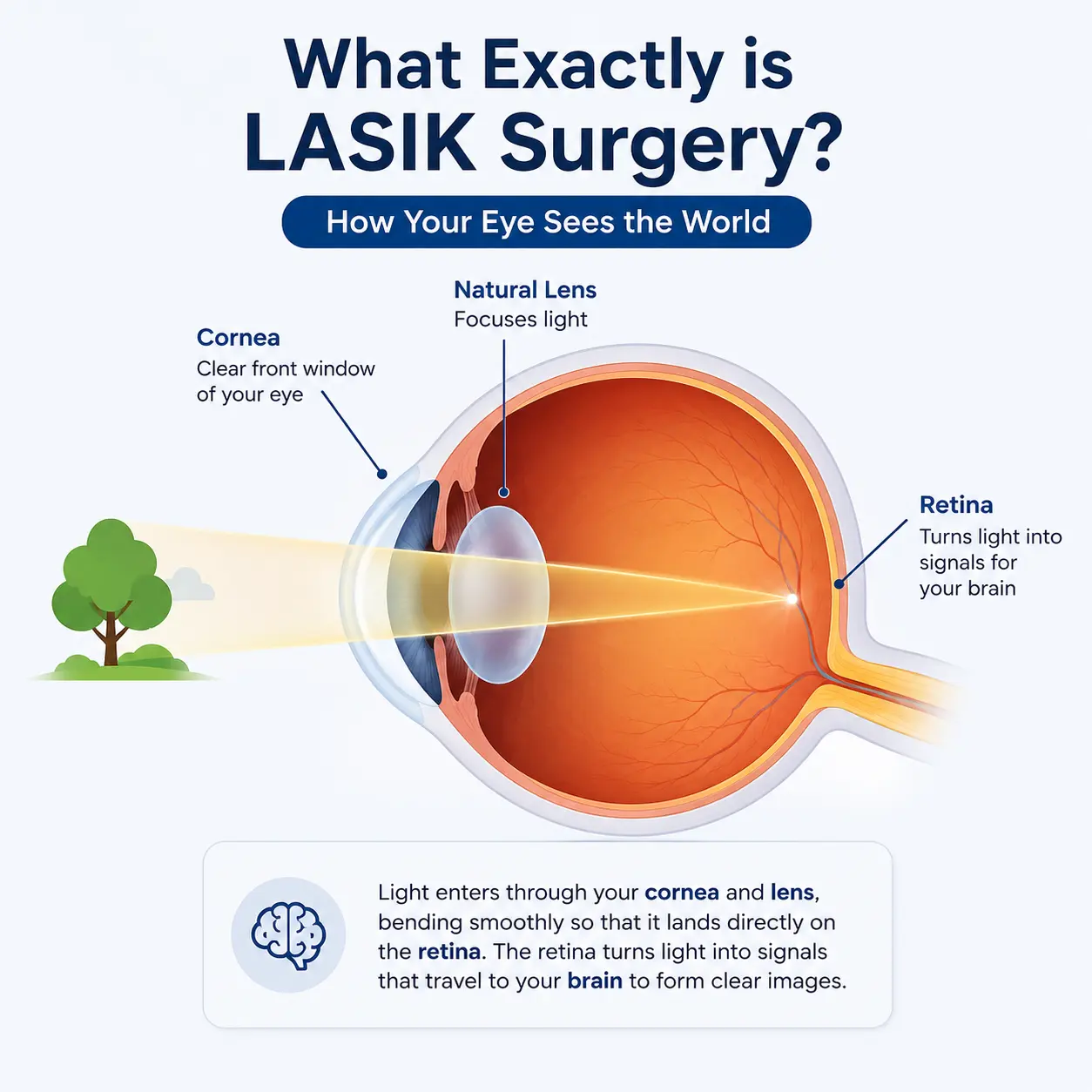
LASIK surgery is a type of laser vision correction that reduces your dependence on glasses or contact lenses.
To understand how it works, it helps to know one simple thing about the eye.
The cornea, which is the clear front surface of the eye, bends incoming light so it focuses on the retina, the light-sensitive layer at the back of the eye. When the cornea doesn’t bend light correctly, your vision becomes blurry.
This happens in common conditions such as:
- Myopia (minus power): Light focuses in front of the retina, making distant objects appear blurry.
- Hyperopia (plus power): Light focuses behind the retina, making nearby objects difficult to see.
- Astigmatism: An uneven corneal shape causes light to focus at multiple points instead of one, leading to blurred or distorted vision.
LASIK reshapes the cornea using a highly precise laser so that light focuses correctly on the retina. The goal is simple: clearer vision with less dependence on glasses or contact lenses.
What Is the Minimum Age for LASIK Surgery?
Legally and medically, most people need to be at least 18 years old before undergoing LASIK. However, meeting the minimum age requirement doesn’t automatically mean you’re ready for surgery.
One of the first questions I ask during a LASIK evaluation is:
“Has your glasses number changed over the last year?”
If the answer is yes, I usually recommend waiting.
Your eye power often continues to change during the late teenage years and sometimes into your early twenties. If LASIK is performed while your prescription is still changing, your vision may continue to change even after surgery.
That’s why, in clinical practice, as an ophthalmologist in Navi Mumbai, I prefer operating once the prescription has remained stable for at least 12 months, even if the patient is already 18.
In my practice, I usually look for two things first:
- You’re at least 18 years old.
- Your glasses or contact lens power has remained stable for at least one year.
Only after these basic requirements are met do I move on to the detailed eye examination.
Is There an Upper Age Limit for LASIK?
This is another question I hear frequently.
“I’m 45. Am I too old for LASIK?”
In many cases, the answer is no.
There is no fixed upper age limit for LASIK. I’ve seen patients in their 40s and even 50s who were suitable candidates because their eyes were otherwise healthy.
However, age does bring another factor into the picture.
Around the age of 40, almost everyone develops presbyopia, a normal age-related change in which the eye gradually loses its ability to focus on nearby objects.
This is important because LASIK changes the shape of the cornea, but it cannot prevent the natural ageing of the eye’s internal lens.
That means someone over 40 may enjoy excellent distance vision after LASIK but still need reading glasses for books, menus or mobile phones.
For selected patients, options such as monovision LASIK may reduce the need for reading glasses, but it isn’t suitable for everyone. During a consultation, I usually recommend trying monovision with contact lenses first to see whether the brain adapts comfortably before making it permanent.
Age Isn't the Only Thing That Matters
This is probably the biggest misconception about LASIK.
Many people think eligibility for LASIK surgery depends only on age.
It doesn’t.
A thorough LASIK evaluation looks at the overall health of your eyes.
Before recommending surgery, I routinely assess:
- Whether your glasses power has been stable.
- The thickness of your cornea (pachymetry).
- The shape of your cornea using corneal topography.
- The quality of your tear film to check for dry eye.
- Your retinal health after dilating the pupils.
- Whether conditions such as keratoconus, glaucoma or cataracts are present.
These tests tell me much more than your age ever can.
Sometimes a healthy 42-year-old is an excellent candidate, while a 22-year-old may be advised to wait because their prescription is still changing.
That’s why a proper evaluation is far more valuable than trying to decide based on age alone.
Who Is Usually a Good Candidate?
In general, you are a good candidate for LASIK if you:
- Are at least 18 years old.
- Have had a stable glasses prescription for at least one year.
- Have healthy corneas with adequate thickness.
- Do not have uncontrolled eye disease.
- Understand what LASIK can and cannot achieve.
You may need a different treatment if you have severe dry eyes, keratoconus, advanced cataracts, uncontrolled diabetes, or a prescription that falls outside the safe treatment range. In these situations, alternatives such as TransPRK, or implantable contact lenses (ICL) may be more appropriate depending on your individual eye examination.
Final Thoughts
If you’re wondering whether this is the right time for LASIK, don’t focus only on your age.
A successful outcome depends on having stable vision, healthy corneas, and a thorough preoperative assessment. These factors are far more important than whether you’re 22 or 42.
The best way to know if LASIK is right for you is to have a detailed evaluation with an ophthalmologist who performs refractive surgery. During that visit, you’ll receive clear answers based on your eye measurements, not guesswork.