
Difference Between Glaucoma and Cataract: What’s Really Affecting Your Vision?
Table of Contents
Quick summary
- Cataract is clouding of the eye’s natural lens. It commonly causes blurry or hazy vision, glare, faded colours and difficulty seeing at night.
- Glaucoma damages the optic nerve and can cause permanent vision loss. In its early stages, it often causes no noticeable symptoms.
- The biggest difference between Glaucoma and Cataract: Cataract-related vision loss can usually be improved with cataract surgery. Glaucoma treatment is aimed at protecting the optic nerve and preventing further vision loss.
- You can have both conditions at the same time.
- A normal eye-pressure reading does not automatically rule out glaucoma.
- If your vision has changed, don’t assume it’s “just cataract.” A comprehensive eye examination is the safest way to understand what is actually happening.
Your vision has started feeling a little different.
Maybe your glasses don’t seem to be helping as much, night driving has become uncomfortable, or things look slightly hazy. You naturally wonder, “Is this a cataract?” And then someone mentions glaucoma, and you start wondering if the two are actually related.
If you’ve been searching for the difference between glaucoma and cataract, you’re not alone. Both become more common with age and can affect your vision, but they affect completely different parts of the eye, and the way we treat them is very different.
The important thing is that you can’t always tell cataract and glaucoma apart just by noticing changes in your vision. Sometimes, the only way to know what’s really happening is through a proper eye examination.
Cataract vs glaucoma: What is the actual difference?
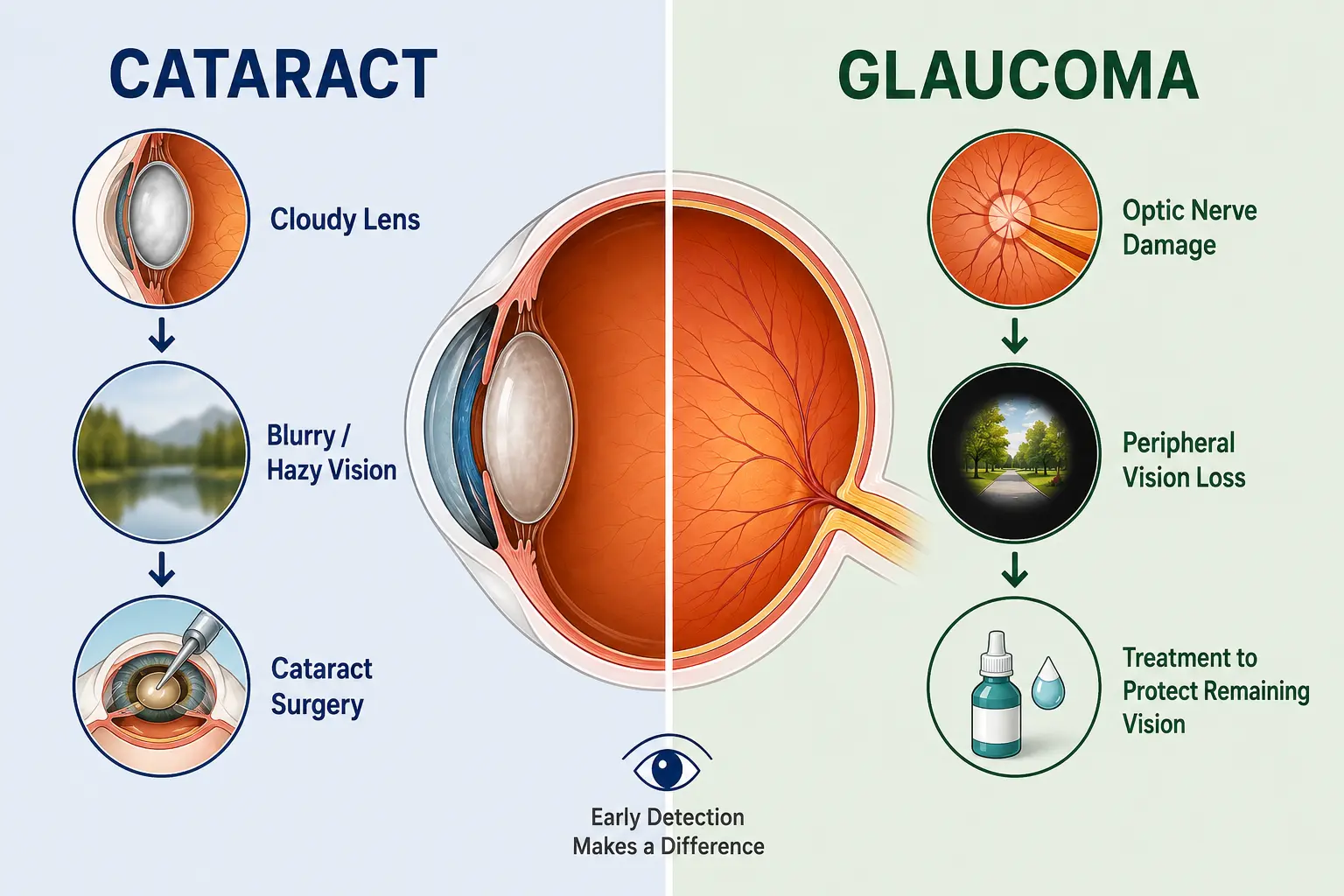
The simplest way to remember it is:
Cataract = a problem with the lens.
Glaucoma = a problem with the optic nerve.
Cataract | Glaucoma | |
Affects | Natural lens | Optic nerve |
Vision changes | Cloudy, blurry, hazy | Often peripheral vision first |
Early symptoms | May be mild or absent | Often none |
Glare/night vision | Common | Not usually the first sign |
Pain | Usually painless | Usually painless in common forms |
Treatment goal | Improve vision | Protect remaining vision |
Main treatment | Cataract surgery | Drops, laser or surgery |
Existing damage reversible? | Vision can usually be restored/improved | Existing optic nerve damage cannot currently be reversed |
The difference isn’t merely academic.
It changes how urgently we need to identify the problem and what treatment is appropriate.
What does a cataract actually feel like?
A cataract usually develops gradually, so you may first blame age or assume you simply need a new glasses prescription.
Then the little things start adding up, you turn up your phone brightness, need more light to read, find headlights uncomfortable or notice that colours don’t look quite as vivid.
These can all be signs that a cataract is affecting your vision. A cataract forms when the eye’s natural lens becomes cloudy, making it harder for light to pass through clearly.
Common symptoms include:
- Blurry or cloudy vision
- Difficulty seeing at night
- Glare or halos around lights
- Faded or yellowish colours
- Frequent changes in glasses prescription
- Double vision in some cases
A cataract may not cause noticeable symptoms and doesn’t always require immediate surgery. If it isn’t affecting daily activities, as an ophthalmologist, we may simply monitor it. Surgery is considered when it starts affecting your quality of life.
What makes glaucoma different?
Glaucoma can be harder to catch because you may not notice anything in the early stages. It often affects peripheral vision gradually, while your brain compensates for the changes.
You may continue reading, using your phone and going about your day without realising anything is wrong.
That’s why waiting for obvious vision loss isn’t a good idea. By the time you notice your side vision changing, glaucoma may have already progressed.
“Is glaucoma simply caused by high eye pressure?”
Not exactly. High eye pressure is an important risk factor, but it doesn’t automatically mean you have glaucoma, and glaucoma can occur even when eye pressure is normal. (Glaucoma.org)
That’s why an eye examination also looks at the optic nerve and visual field, not just your pressure reading.
Cataract vs glaucoma symptoms: Can you tell which one you have?
Sometimes the symptoms provide clues.
With cataract, you are more likely to notice:
“My vision looks cloudy.”
“Lights are bothering me.”
“Colours don’t look the same.”
“Night driving has become difficult.”
With early glaucoma, you may have no such complaint.
But as it progresses, you might experience gaps in your peripheral vision or start bumping into objects.
But these symptoms aren’t enough to diagnose glaucoma. Blurred vision can have many other causes, and the absence of symptoms doesn’t rule out glaucoma either.
So if you’ve been searching for “cataract vs glaucoma symptoms,” use it as a reason to get your eyes checked, not to diagnose yourself.
Can you have cataract and glaucoma together?
Absolutely.
Patients are often surprised by this because cataract affects the lens, while glaucoma affects the optic nerve. Having one doesn’t protect you from the other.
We recently had a patient at Suruchi Eye Hospital, thinking her cloudy vision was simply due to cataract. Her examination also showed signs of glaucoma, a good reminder that vision changes can sometimes have more than one cause.
You can have:
- Cataract without glaucoma
- Glaucoma without cataract
- Both together
When both are present, treatment needs to be planned carefully. Cataract surgery may improve cloudy vision, while glaucoma treatment continues to protect the optic nerve. In some cases, both procedures may be combined, depending on the patient’s eye health.
How does an ophthalmologist actually tell the difference between glaucoma and cataract?
This is where a good eye examination goes beyond simply checking whether you can read the letters on a chart. Understanding the difference between glaucoma and cataract also means knowing what your ophthalmologist is actually looking for.
For cataract, we examine the lens to determine whether it has become cloudy and how much that clouding is affecting your vision.
For glaucoma, the assessment is broader.
Depending on your age, symptoms and risk factors, your ophthalmologist may evaluate:
- Eye pressure: Gives us information about intraocular pressure.
- Optic nerve: We look for structural changes that may indicate damage.
- Visual field: Helps identify functional changes, especially in peripheral vision.
- OCT: Provides detailed images of the optic nerve and retinal nerve fibre layer.
- Gonioscopy: Helps assess the drainage angle and determine the type of glaucoma.
- Pachymetry: Measures corneal thickness, which can influence how eye-pressure readings are interpreted.
This is important because there isn’t one “glaucoma test.”
A patient may have a pressure reading that looks reassuring but have suspicious optic-nerve changes. Another may have elevated pressure but no evidence of glaucoma damage.
The diagnosis comes from putting these pieces together.
That is also why glaucoma monitoring isn’t simply about asking, “What is my eye pressure today?”
We want to know whether the optic nerve and visual field are remaining stable over time.
How is cataract treated?
If a cataract is mild, you may not need surgery right away. Better lighting, anti-glare measures or updated glasses can sometimes help for a while.
Once it starts affecting everyday activities, however, cataract surgery is the definitive treatment. The cloudy natural lens is removed and replaced with an artificial intraocular lens (IOL), and around 9 in 10 people see better after surgery.
The timing depends on how much the cataract is affecting your daily life. Simply having a cataract doesn’t mean you need surgery immediately. A useful question to ask is:
“How much of my vision problem is actually because of the cataract?”
How is glaucoma treated?
The objective is completely different.
With cataract surgery, we’re removing the cloudy lens that’s affecting vision.
With glaucoma, we are trying to prevent further optic nerve damage.
Treatment may involve:
- Prescription eye drops
- Laser treatment
- Glaucoma surgery
The choice depends on the type and severity of glaucoma, your pressure, optic nerve appearance, visual-field changes and how the disease behaves over time.
And here’s something that often frustrates patients:
Glaucoma drops may not make your vision feel better.
That’s because they aren’t intended to make you suddenly see more clearly. Their purpose is to lower eye pressure and help protect the optic nerve from further damage.
So if you have been prescribed glaucoma medication and think, “My eyes feel exactly the same, so perhaps I don’t need these anymore,” please discuss that with your ophthalmologist before stopping treatment.
Can glaucoma damage be reversed?
This is perhaps the most important difference between the two conditions.
With cataract, the cloudy lens can be surgically removed, and vision affected by the cataract can generally improve.
With glaucoma, damage that has already occurred to the optic nerve cannot currently be reversed.
Treatment is about preserving the vision that remains and slowing or stopping further damage.
That is why early detection matters so much.
A person with early glaucoma may feel perfectly fine. But finding the disease at that stage gives us an opportunity to begin treatment before more vision is lost.
What happens if you have both cataract and glaucoma?
This is where individual assessment becomes particularly important.
Suppose someone has significant cataract causing cloudy vision and also has glaucoma.
Removing the cataract may improve the cloudy component of their vision. But it doesn’t erase the glaucoma or repair an already damaged optic nerve.
So the doctor needs to determine:
- How much of the vision problem is due to cataract?
- How advanced is the glaucoma?
- Is the glaucoma controlled?
- Is the optic nerve stable?
- What treatment is currently being used?
- Would cataract surgery alone be appropriate?
- Would combined treatment make sense?
There isn’t one answer for every patient.
And this is exactly why an eye examination should be about more than simply identifying a cataract and saying, “Let’s operate.”
What’s worse: Cataract or Glaucoma?
Neither is simply “worse”.
They just need to be taken seriously for different reasons.
A cataract can gradually make your vision cloudy and difficult, but the vision it affects can usually be improved with cataract surgery.
Glaucoma is more concerning in one particular way: the optic nerve damage it causes cannot be reversed, which is why catching and treating it early matters.
When should you get your eyes checked?
Don’t wait for severe vision loss.
If you’re experiencing persistent changes such as blurred vision, glare, difficulty seeing at night or changes in your peripheral vision, arrange an eye examination.
Regular examinations are particularly important if you have risk factors for glaucoma, such as a family history of the disease or other factors your ophthalmologist identifies.
And there is one situation where you should not wait for a routine appointment.
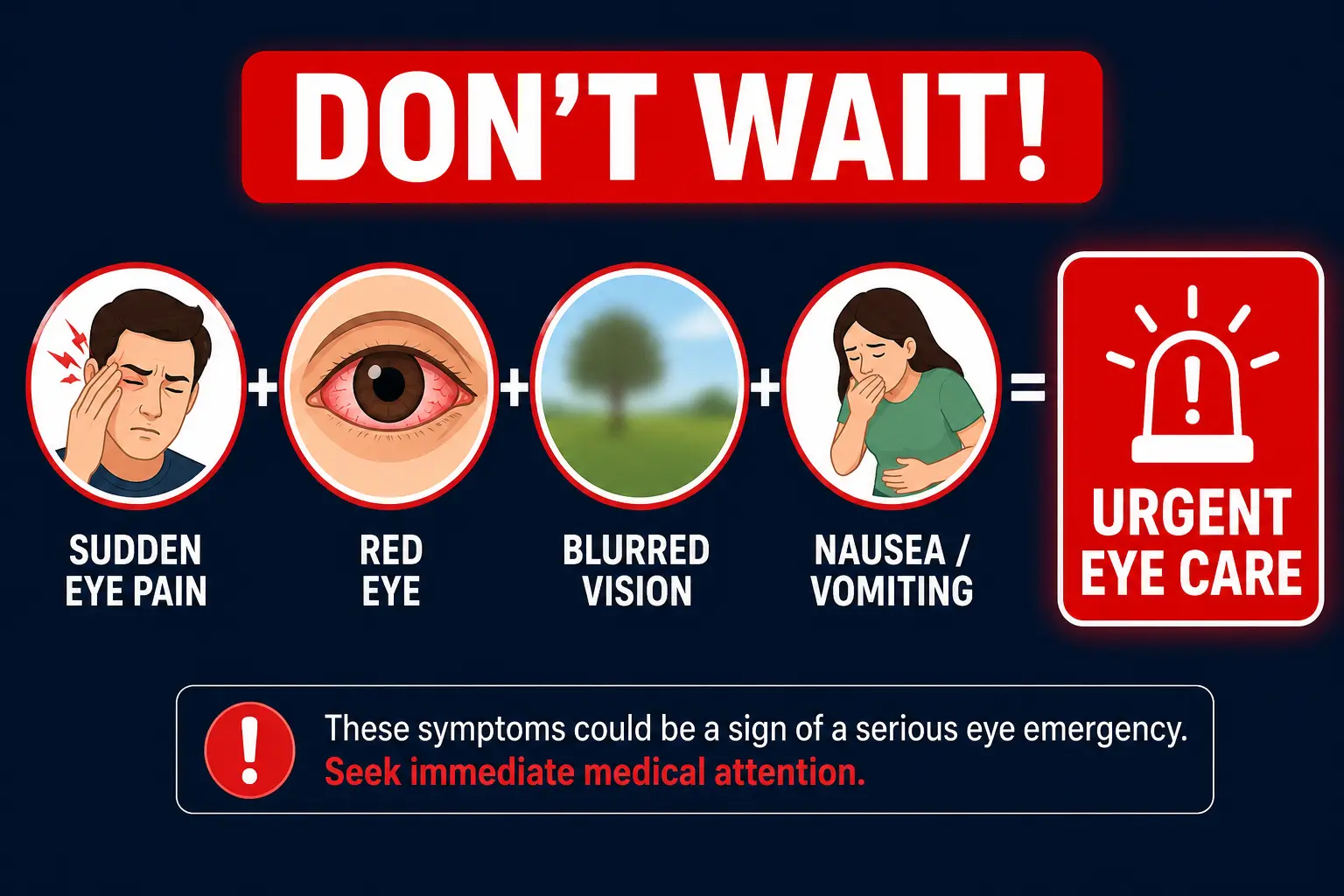
Sudden severe eye pain accompanied by a red eye, blurred vision, nausea or vomiting can indicate acute angle-closure glaucoma, which is an eye emergency.
Don’t wait for the pain to settle on its own. Seek urgent medical attention.
“Cataract or glaucoma?” The examination matters more than the guess
It can be tempting to blame changing vision on “just getting older” or assume it’s a cataract. But understanding the difference between glaucoma and cataract is important: cataract affects the lens, while glaucoma affects the optic nerve, and you can have both.
A comprehensive eye examination can help identify what’s actually affecting your vision and whether you need treatment or simply monitoring.
At Suruchi Eye Hospital, Navi Mumbai, the focus is on finding the reason behind your vision changes rather than leaving you to guess. When it comes to your eyesight, an examination is far more useful than an assumption.