
ICL vs LASIK: Which One Is Best For You?

MBBS, M.S. in Ophthalmology | 25+ years of Experience
Table of Contents
Quick Answer
Neither surgery is better for everyone.
LASIK uses a laser to reshape the cornea (the clear front window of the eye) and usually suits people with low to moderate power and a healthy, thick enough cornea.
ICL places a thin, soft lens inside the eye without removing any corneal tissue, so it is often advised when the power is high, the cornea is thin or irregular, or the eyes are already dry.
If your friend got LASIK and you were told ICL, it usually means your eye measurements were different, not that your eyes are in bad shape.
You and your college friend booked eye tests in the same month.
Both of you have worn glasses since school. Both of you were tired of them.
She came out of her test with a date for LASIK. One week later, she was back at work, sending you selfies without specs.
You came out with a different note: “Better suited for ICL.”
Same city, same wish, two different answers. So now you are searching ICL vs lasik, wondering if someone made a mistake, or if your eyes are somehow “worse”.
I am Dr. Rajesh Kapoor, MS (Ophthalmology), and I run Suruchi Eye Hospital in Airoli, Navi Mumbai.
Let me explain why two people with the same goal can get different advice, how each surgery works, the risks of both, and how I decide which one fits.
ICL vs LASIK: how do the two surgeries actually work?
LASIK changes the shape of your cornea. ICL leaves the cornea alone and adds a lens inside the eye.
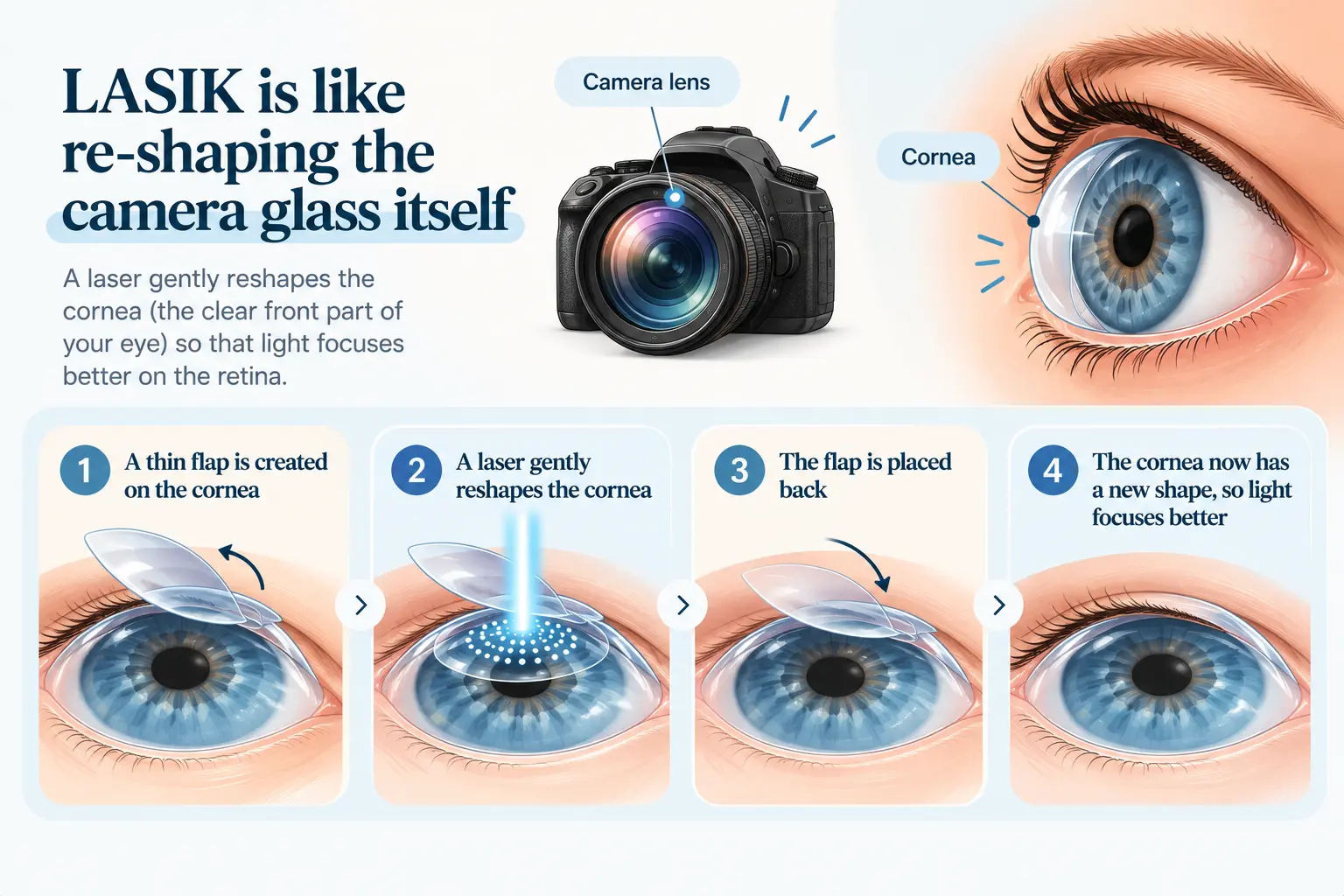
Let’s get into the science behind LASIK. In LASIK, a thin flap is made on the cornea, a laser removes a precise amount of tissue underneath to correct the power, and the flap is placed back. At Suruchi, we do CONTOURA LASIK, where the laser plan is guided by a detailed map of the cornea.
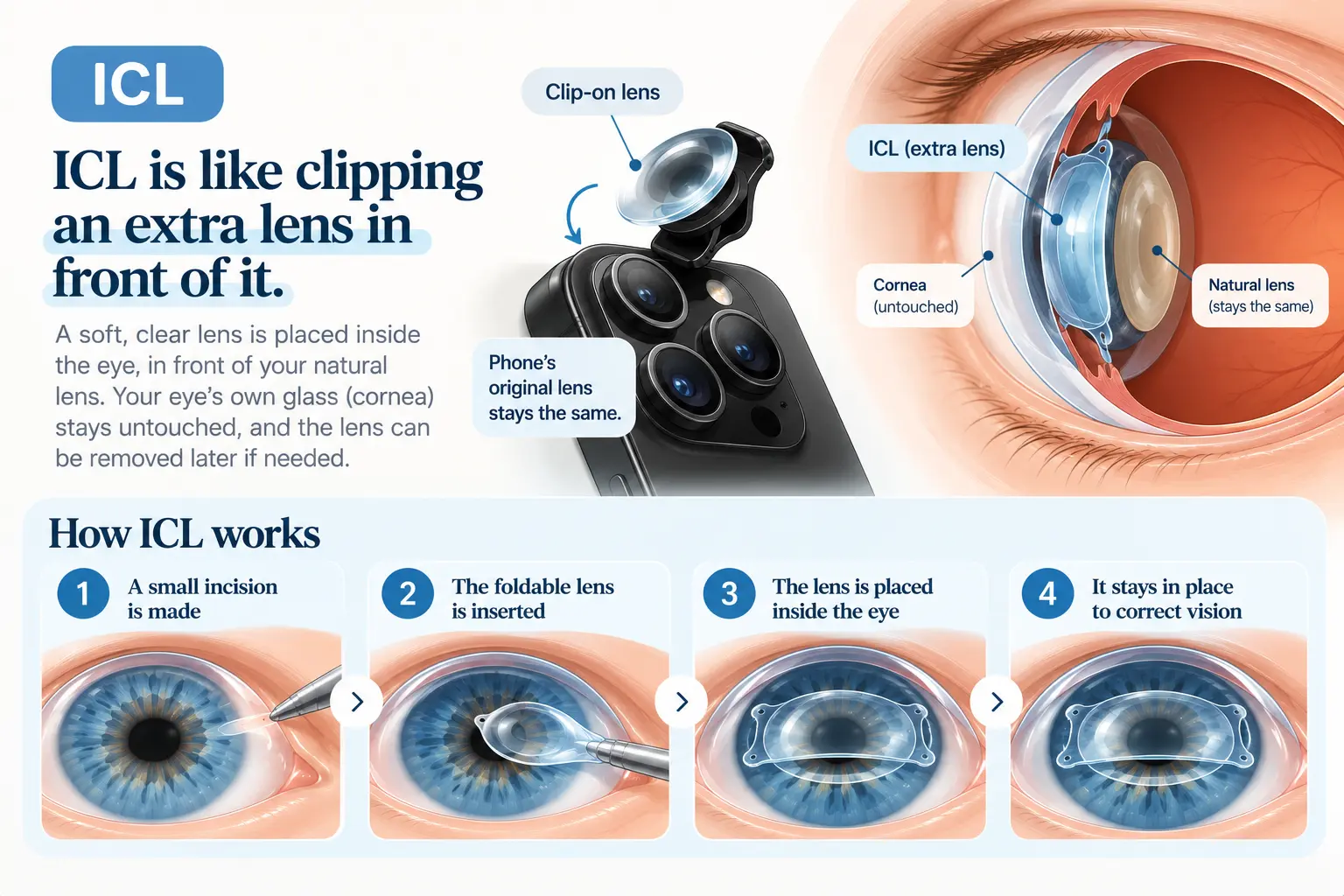
ICL stands for Implantable Collamer Lens. This soft, foldable lens goes in through a tiny opening at the edge of the cornea. It sits behind the coloured part of the eye (the iris), in front of your own natural lens. Nothing is removed.
Think of a phone camera.
LASIK is like re-shaping the camera glass itself so it focuses better.
ICL is like clipping an extra lens in front of it. The phone’s own glass stays untouched, and the clip-on can come off later if needed.
Your friend’s eyes could safely take the first route. The question is why yours might not.
“We both had glasses. Why did she get LASIK and I didn't?”

Because LASIK depends on how much cornea you can safely spare, and that is different in every eye.
Picture two people giving the same trousers to a tailor to take in. One pair has plenty of extra cloth in the seam. The other has almost none. The tailor can alter the first easily. Cutting the second would weaken the whole piece.
The cornea works the same way. The higher the power, the more tissue the laser has to remove. If the cornea is already thin, removing more can weaken it, and a weak cornea can slowly bulge and blur vision.
So the difference between you and your friend usually comes down to a few things:
- Power: your number may simply be higher than hers
- Corneal thickness: hers may have more tissue to spare
- Corneal shape: your scan may show an irregular, cone-like pattern (an early sign of a condition called keratoconus) that rules out LASIK
- Dry eye: if your eyes are already dry, LASIK can make that worse
None of these is your fault. You are born with your corneal thickness, the same way you are born with your height.
Many young people I meet from Airoli, Thane and the IT parks nearby work long hours on laptops, and some already have dry, tired eyes before we even talk about surgery.
Your friend may tell you, “Main toh ek din mein office chali gayi, tu bhi LASIK karva le.”
She means well. But her scan is not your scan.
LASIK vs ICL: which is better if my number is higher than my friend's?
LASIK works very well for many people with low to moderate minus power, helping them achieve clear vision with less dependence on glasses. Even with a higher number, you may still be eligible for LASIK.
The US FDA notes that results may be less predictable with very high prescriptions. A Cochrane review found some advantages for lens implants in people above minus 6 power, including better contrast sensitivity and a lower risk of losing best-corrected vision at one year.
That review is from 2014, and laser technology has improved since. Its findings are useful guidance, not a rule that makes ICL better for everyone.
Your corneal thickness, shape, prescription stability and eye health all matter when choosing a procedure. A higher number does not automatically rule out LASIK. The next question is usually about safety.
“Is ICL riskier than what my friend had?”
Not riskier overall in the right eye, but the risks are different, because LASIK works on the surface and ICL works inside the eye.
With LASIK, the main risks are:
- Dry eye, which settles for most people but can last long in some
- Glare, halos or starbursts around lights at night
- Power left over (under-correction or over-correction), which may need glasses or a touch-up
- Rarely, weakening of the cornea if it was too thin to start with
With ICL, the main risks are:
- Raised pressure inside the eye, which may need drops or a small procedure
- Cataract (clouding of your natural lens) earlier than usual. If it happens, the ICL is removed during cataract surgery
- Slow loss of the inner cell layer of the cornea, which keeps the cornea clear. This is why it is measured before and after surgery
- Halos at night
- The lens may need repositioning or changing if the size or power is not right
- Rare but serious problems of any inside-the-eye surgery, such as infection
Patients often ask me, “Doctor, will the lens move or fall out?” The lens sits in a fixed space behind the iris, and you cannot feel it. Rarely, it needs adjusting, which is one reason follow-up visits matter.
One honest point for both of you. Neither surgery promises a life without glasses forever. Both correct today’s power. Neither stops the reading glasses most people need after 40.
| LASIK | ICL | |
|---|---|---|
| How it works | Laser reshapes the cornea | Lens placed inside the eye |
| Corneal tissue | Some removed | None removed |
| Usually suits | Low to moderate power, healthy cornea | High power, thin or irregular cornea, dry eyes |
| Can it be reversed? | No, the change is permanent | Yes, the lens can be removed |
| Main risks | Dry eye, night glare, thin cornea problems | Raised eye pressure, earlier cataract, corneal cell loss |
| Reading glasses after 40 | Still likely | Still likely |
| Cost | Generally lower | Generally higher, as the lens is ordered for your eye |
ICL vs LASIK at a glance. Your test results decide which column is yours.
What I check when you come to the clinic?
I start with your story before any machine.
I ask how your power has changed, whether you wear contact lenses, whether your eyes feel dry, what work you do and how much you drive at night. I also ask about diabetes, pregnancy and medicines, because these can affect your vision, prescription or healing. If you have diabetes, it is also important to check for diabetes-related eye problems before planning surgery.
Then come the tests:
- Corneal thickness to see how much tissue can be safely removed
- Corneal map to check for an irregular or cone-like shape
- Tear tests to check for dry eye
- Pupil size in dim light, as large pupils can increase the risk of night-time halos
- For ICL, the space inside the eye in front of your natural lens, along with a count of the cells lining the inside of the cornea
- A dilated retina check, because high minus eyes can have retinal changes that need attention first
Before you buy a bigger car in Navi Mumbai, you check whether it fits in your building’s parking slot. ICL is similar. The lens needs enough space inside your eye. If the space is too shallow, the lens may not fit safely. The US approval specifies a minimum anterior chamber depth of 3 mm for the relevant ICL. If you do not meet the criteria, I will not recommend it, however much you want it.
When is it better to wait, or stay with glasses?
Sometimes the honest answer is “not yet”, even if your friend is already glasses-free.
I usually ask people to wait if:
- Your power has changed in the last year
- You are in your early twenties and the number is still moving
- You are pregnant or breastfeeding
- Your diabetes is not well controlled
- You have an eye infection or active inflammation
- You play contact sports like boxing or martial arts, where the eye can take hits (this matters more for LASIK)
If you are over 40 and the scans show early cataract, a lens surgery that also treats the cataract may make more sense later.
Glasses and contact lenses are still safe ways to see. Surgery is a choice, not a need.
After surgery: what is normal, and when to call us?
Usually normal in the first days
- Watering, a gritty or scratchy feeling, and mild light sensitivity
- Vision that is a little up and down
- Some halos around lights at night, which often get less over the first weeks
Please give us a call if you notice these symptoms:
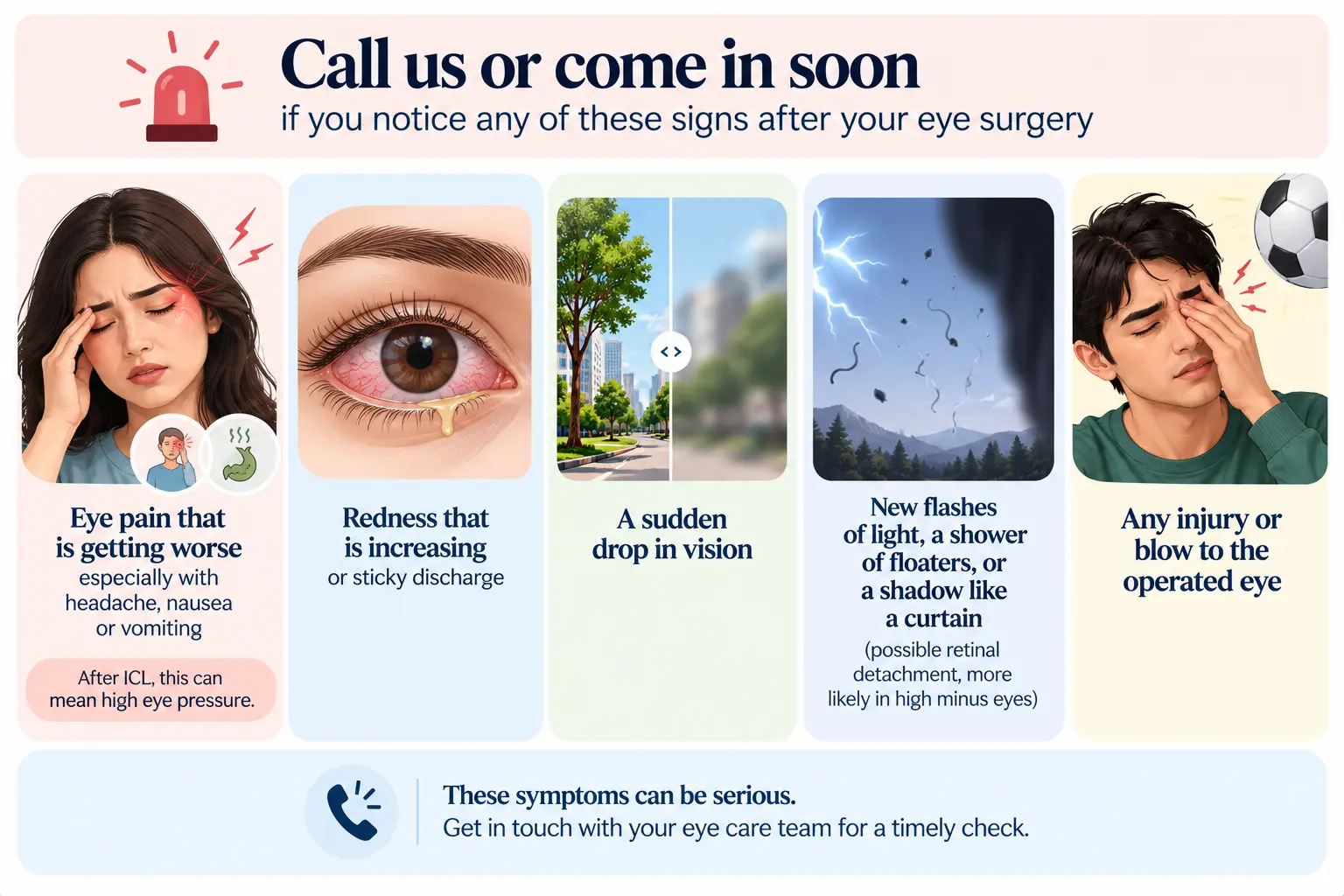
- Eye pain that is getting worse, especially with headache, nausea or vomiting.
- A sudden drop in vision
- New flashes of light, a shower of floaters, or a shadow like a curtain (possible retinal detachment, more likely in high minus eyes)
- Any injury or blow to the operated eye
FAQs
Generally, yes. The lens is ordered to suit your eye’s size and power, and the surgery takes place inside the eye. Ask for the full cost, including tests and follow-ups, before you decide.
Ask both for their reasons and for your corneal thickness and map results. If one doctor says no and another quickly says yes, the reasons will tell you more than the answer.
Most people feel pressure rather than pain, as the eye is numbed first. Mild discomfort for a day or two is common.
After LASIK at Suruchi, most people return to work within 24 to 48 hours. ICL recovery is also quick, but you need follow-up visits in the first week.
Both are meant to be long-term. LASIK permanently reshapes the cornea. An ICL can stay in the eye for many years, but it is usually removed if you later need cataract surgery.
Same goal, different road
You and your friend wanted the same thing: to wake up and see the clock without reaching for your glasses.
Her road was LASIK. Yours may be ICL. Neither is the “better” eye. They are just different eyes.
The real answer to ICL vs LASIK is not which surgery your friend had. It is which one your cornea, your inner eye space and your daily life can safely support.
If you are in Airoli, Navi Mumbai, Thane or nearby and want a clear answer for your own eyes, bring your old prescriptions and any earlier test reports, and come for a refractive check-up with us. We will go through every result with you before anything is decided.