
Can Cataract Develop Faster in Diabetic Patients?

MBBS, M.S. in Ophthalmology | 25+ years of Experience
Table of Contents
Inputs from Dr. Rajesh Kapoor
A common misunderstanding is that diabetic patients should be afraid of cataract surgery. Even when sugar is not perfectly controlled, surgery can sometimes be performed, so it should not be unnecessarily delayed.
Another misconception is that cataract surgery is the end of treatment. Diabetic patients still need regular retinal follow-up to monitor for diabetic retinal changes.
There is no universal HbA1c or blood-sugar cutoff for cataract surgery. The decision depends on overall diabetic control, current sugar levels, other medical conditions, and retinal health. Surgery may be delayed if diabetes is severely or unstably controlled, based on the surgeon’s individual protocol.
Diabetic patients follow the routine postoperative schedule but may require additional or longer-term retinal follow-up, especially if diabetic retinopathy or macular edema is present. The frequency depends on the individual patient’s risk.
In younger diabetic patients, cataracts may develop earlier and progress faster. Early cataract can also be a reminder of the importance of lifelong diabetes control and regular retinal follow-up to monitor for diabetic retinopathy.
Key Takeaways
- Yes, cataracts can develop or progress earlier in people with diabetes, but diabetes does not mean every cataract will develop faster.
- Diabetes increases the risk of developing cataracts.
- People with diabetes may develop cataracts at a younger age.
- There is no fixed timeline for how quickly cataracts progress in diabetic patients.
- Age and blood sugar control are among the factors linked with cataract development.
- Regular eye check-ups can help us track changes and understand how the cataract is progressing.
You notice that your vision is not as clear as it used to be.
Reading small print takes more effort.
Headlights look too bright at night.
Maybe you have even changed your glasses recently, but things still look a little cloudy.
Then you think: Could diabetes be making your cataract develop faster?
It is a reasonable question. This is one of the questions I hear most from patients with diabetes at Suruchi Eye Hospital in Navi Mumbai. Here is how I explain it to my patients.
The link between diabetes and cataract is well established, and people with diabetes may develop cataracts at a younger age. The National Eye Institute notes that people with diabetes are 2 to 5 times more likely to develop cataracts and may develop them earlier than people without diabetes.
But there is an important part of the answer that is easy to miss:
Diabetes does not mean that your cataract will always grow quickly.
Cataracts develop differently from person to person. Your age, how long you have had diabetes, blood sugar control, and other factors can all affect your risk. A common misunderstanding I often see in my diabetic patients is that diabetic patients should be afraid of cataract surgery. Even when sugar is not perfectly controlled, surgery can sometimes be performed, so it should not unnecessarily be delayed.
Another misconception is that cataract surgery is the end of the treatment. Diabetic patients still need regular retinal follow-up to monitor for diabetic retinal changes.
So, if you have diabetes and have been told you have a cataract, what does that actually mean?
Let’s break it down for you.
First things first: What is a Cataract?
A cataract happens when the clear lens inside your eye becomes cloudy.
Think of the lens as a small, clear window inside your eye. It helps focus light so that you can see things clearly.
As a cataract develops, that clear lens slowly becomes cloudy. Light does not pass through it as easily, so your vision may become blurry or hazy.
You may notice:
- Blurry or cloudy vision
- Trouble reading
- Difficulty seeing at night
- Headlights or lamps appearing unusually bright
- Faded-looking colours
- Needing brighter light to see
- Changing your glasses prescription more often
Cataracts usually develop slowly, and you may not notice any symptoms when they are small.
Can Diabetes Cause Cataracts?
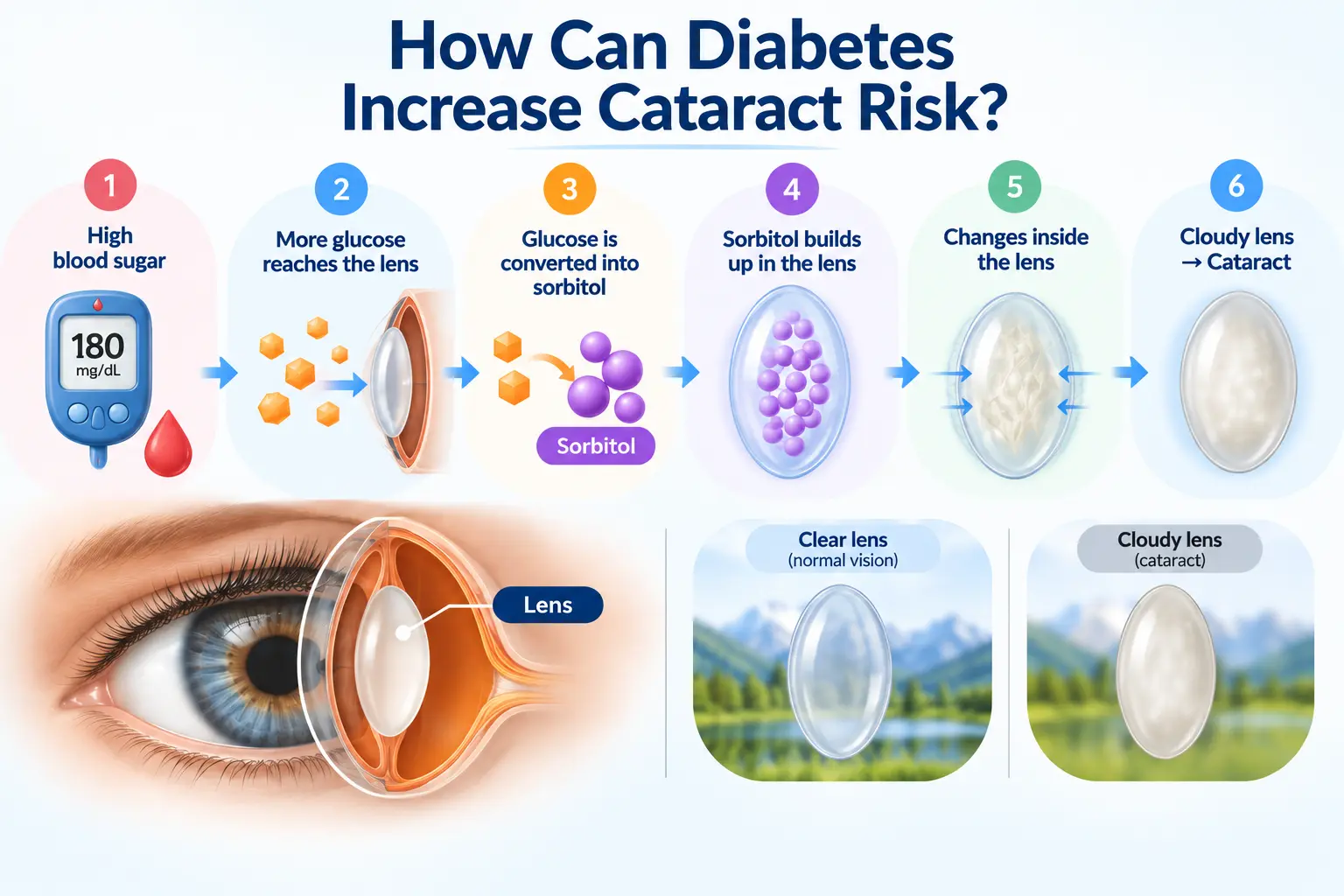
Diabetes can increase your risk of developing cataracts.
Ageing is the most common reason people develop cataracts. But diabetes is one of the health conditions that can increase the risk.
Research supports this connection. A systematic review of studies in people with type 2 diabetes found that age and blood sugar control were consistently associated with cataract development.
Another study looking at people with type 2 diabetes found that the risk of developing cataracts was higher in people with longer diabetes duration.
This does not mean diabetes is the only cause of cataract.
Instead, diabetes is one factor that can make cataract more likely, especially when combined with other factors such as ageing.
Being aware of your cataract risk can help you recognise changes in your vision early and get your eyes checked when needed.
Why Does Diabetes Increase Cataract Risk?
To understand this, it helps to look at what happens inside the lens.
Your lens needs a very carefully balanced environment to stay clear. When blood sugar levels are high, more glucose can reach the lens.
Some of this glucose is changed into a sugar alcohol called sorbitol.
Sorbitol can build up inside the lens and affect its normal balance. This can cause changes in the lens that may contribute to cloudiness.
Think of it like this:
Imagine a clear sponge.
The sponge needs to maintain the right amount of water to stay in its normal shape. If something causes it to take in too much water, its structure can change.
Something similar can happen inside the lens when excess glucose is converted into sorbitol.
This is one of the biological reasons researchers have linked diabetes with cataract development.
It is also why a cataract in a person with diabetes is not simply about getting older. Diabetes can add another type of stress to the lens.
Does Cataract Develop Faster in People With Diabetes?
It can, but there is no fixed timeline.
This is one of the most important things to understand about cataract progression in diabetes.
Having diabetes does not mean that a cataract will suddenly become severe within a certain number of months or years.
Every person’s eyes are different.
For example, two people may both have type 2 diabetes and be the same age. One may have a small cataract that changes very slowly. The other may develop more noticeable lens changes earlier.
Research has found that diabetes is associated with a higher risk of cataract, but cataract development and progression are also influenced by factors such as age and blood sugar control.
So instead of asking, “How fast will my cataract grow?”, we look at the bigger picture:
- How cloudy is the lens?
- How much has your vision changed?
- Is the cataract affecting your daily activities?
- How well is your diabetes being managed?
- Are there other changes in the eye?
This is why one person’s experience with a diabetic cataract cannot be used to predict another person’s experience.
Does High Blood Sugar Make Cataracts Worse?
Blood sugar control is one factor that matters.
A systematic review of type 2 diabetes studies found a consistent association between glycaemic control and cataract development.
In simple terms, long periods of high blood sugar may increase the stress on the lens and raise the risk of cataract.
But this does not mean:
“If my blood sugar is controlled, I will never get a cataract.”
People with well-managed diabetes can still develop cataracts, particularly as they get older.
From Dr. Rajesh Kapoor
Many of my diabetic patients tell me their glasses stopped working after only a few months. Often the cataract isn’t the reason. When blood sugar goes up and down, the lens can swell slightly and focus changes for a while. So when a patient’s sugar has been unstable, I usually advise waiting until it settles before getting new glasses. Otherwise, they may pay for a prescription that is wrong a few weeks later.
Good diabetes management is important for overall health and eye health, but it cannot completely remove the natural risk of developing a cataract.
Can Better Blood Sugar Control Reverse a Cataract?
Usually, no.
Once a cataract has formed, improving blood sugar levels does not normally make the cloudy lens clear again.
Managing your blood sugar is still important because it can help reduce the risk of diabetes-related health problems.
But think of it this way:
Good blood sugar control may help protect your eyes; it does not dissolve an existing cataract.
If a cataract is already affecting your vision, we decide whether it needs monitoring or treatment based on your eye exam and how much it affects your daily life.
Does Every Diabetic Patient With Cataract Need Surgery?
No.
Being diagnosed with a cataract does not automatically mean you need cataract surgery. Even when diabetes and cataract occur together, surgery may not be needed right away.
A small cataract may not cause enough trouble to affect your everyday activities. In that case, we may simply monitor it.
So, can cataract be cured without surgery?
Surgery may be discussed when the cataract starts making everyday tasks difficult.
For example, you may find it harder to:
- Read a book or newspaper
- Work on a computer
- Drive at night
- Recognise faces
- Move around safely
- See clearly even with your usual glasses
Cataract surgery is considered when cataracts begin to interfere with everyday activities. So, the decision is not based only on “Do I have a cataract?”
It is also about “How much is this cataract affecting my life?”
When a diabetic patient does need cataract surgery
Cataract surgery in diabetic patients is routine, but I plan it a little more carefully. Before surgery, I check the retina closely, sometimes with an OCT scan of the macula, and I make sure blood sugar is under reasonable control.
In diabetic patients, the macula is more likely to swell after surgery, so my team and I monitor recovery more closely.
For diabetic patients, blood glucose should be adequately controlled before surgery.
The postoperative follow-up schedule is similar to that of a routine patient. However, for diabetic patients, we also recommend retinal evaluation by a vitreoretinal specialist about 1.5–3 months postoperatively. Especially if diabetic retinopathy or macular edema is present. The frequency depends on the individual patient’s risk.
In younger diabetic patients, cataracts may develop earlier and progress faster. Early cataracts can also remind patients of the importance of lifelong diabetes control and regular retinal follow-up to monitor for diabetic retinopathy.
Does Cataract in Diabetes Need Special Monitoring?
People with diabetes should have regular eye examinations, even if their vision seems fine.
When vision becomes blurry, it is important not to assume that a cataract is the only reason. Diabetes can affect different parts of the eye, and more than one problem can sometimes contribute to changes in vision.
This is why a proper eye examination looks at the whole eye, not just the lens. It helps us understand whether the cataract is actually responsible for the vision changes and whether anything else needs attention.
Doctor’s Note
From Dr. Rajesh Kapoor
What I check first in diabetic patients
When a patient with diabetes comes in with blurry vision, I don’t assume it is the cataract. I look at three things:
The lens
How cloudy it is and where the cloudiness sits.
The retina
A dilated eye exam to check for diabetic retinopathy or swelling in the macula, because these can blur vision too.
Diabetes history
How long they’ve had diabetes and their recent HbA1c results.
Only then can I tell a patient how much of their blur is from the cataract and what we should do about it.
Good to know
There is no universal HbA1c or blood-sugar cutoff for cataract surgery. The decision depends on overall diabetic control, current sugar levels, other medical conditions, and retinal health. Surgery may be delayed if diabetes is severely or unstably controlled, based on the surgeon’s individual protocol.
Blurred vision can have more than one cause, so the right treatment depends on finding the actual cause.
Regular eye checks also help us keep track of changes over time instead of waiting until vision becomes difficult in everyday life
What Can You Do to Protect Your Eyes if You Have Diabetes?
You cannot completely prevent every cataract. Cataracts are also a natural part of ageing for many people.
But if you have diabetes, taking care of your overall health and keeping your blood sugar under good control are important parts of protecting your eyes.
Your eye care may include:
- Keeping up with your diabetes treatment plan
- Monitoring your blood sugar as advised by your doctor
- Getting regular eye examinations
- Telling your ophthalmologist about any changes in your vision
- Following your doctor’s advice about other health conditions
- Protecting your eyes from excessive UV exposure
When Should You See an Eye Doctor?
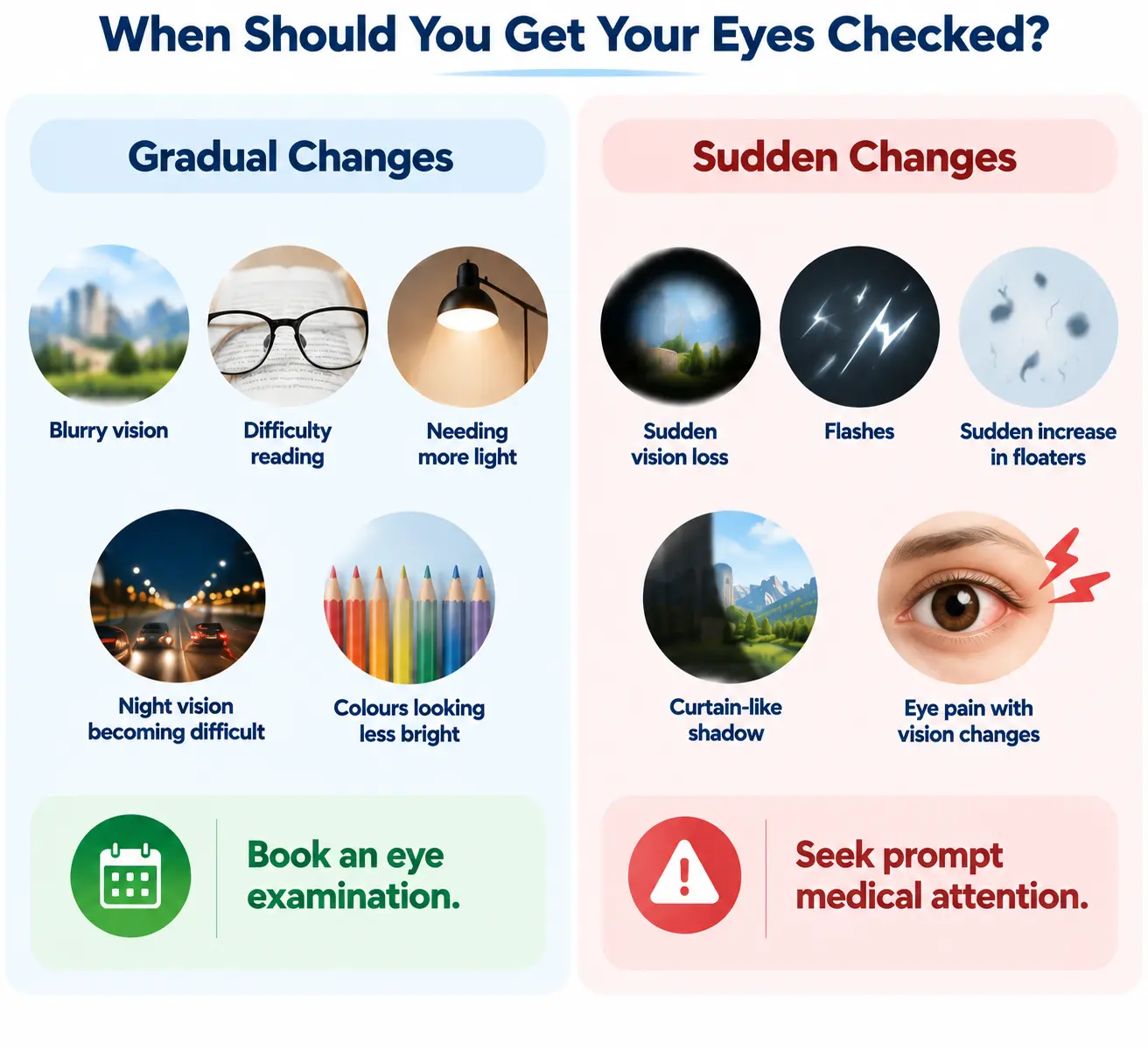
Do not wait for your vision to become very poor before getting your eyes checked.
Make an appointment if you notice gradual changes such as:
- Blurry or cloudy vision
- Difficulty reading
- Needing brighter light
- More difficulty seeing at night
- Colours looking less bright
- Frequent changes in your glasses
- Difficulty recognising faces
Difficultuy reading, difficulty seeing at night, and cloudy vision could be a cataract, but they can also have other causes. An eye examination can help determine what is actually happening.
Some vision changes need more urgent attention
Seek prompt medical attention if you experience:
- Sudden loss of vision
- A sudden major change in vision
- New flashes of light
- A sudden increase in floaters
- A curtain-like shadow across your vision
- Sudden distortion of straight lines
- Eye pain with a change in vision
Do not assume that a sudden change is simply a cataract.
So, Can Cataract Develop Faster in Diabetic Patients?
Diabetes can increase the risk of cataract and can be linked with developing cataracts at a younger age. But it does not mean that every diabetic patient will develop a cataract quickly.
There is no single timeline for cataract progression in diabetes. Age, how long you have had diabetes, blood sugar control, and individual eye health can all affect your risk.
The most important thing is not to panic if you are diagnosed with a cataract. A cataract can often develop slowly, and having one does not automatically mean you need surgery immediately. Regular eye examinations can help us keep track of changes and decide when treatment may be needed.
If you have diabetes and are noticing changes in your vision or have been diagnosed with a cataract, you can consult Dr. Rajesh Kapoor for an eye evaluation and to understand the next steps based on your individual eye health.