
How to Choose Among Different Types of Cataract Lenses?
Table of Contents
You know what, people come to me when they are unable to see properly. As soon as I tell them it is a cataract, they understand that surgery might be necessary. What worries most patients is not the cataract surgery itself, but something more difficult than that. Can you guess?
Yes! Like you, most patients are also worried about choosing the type of lens to replace after cataract surgery. The reason? I tell them that once you choose a particular type of cataract lenses, it is a permanent decision; it cannot be reversed.
When I explain different types of cataract lenses, I help my patients understand the pros and cons of each and why they should or should not prefer one. An interesting individual told me, “Why do you need to have different types of cataract lenses? Why can you have just one?”
I wondered and told him. “We aren’t God. God created a beautiful lens in our eye which adjusts to everything, but unfortunately we cannot achieve the same results when we try to create it manually; therefore, we need to have different lenses”
Like my patients, many of you might be wondering about the types of lenses for cataract. So in this blog, let me explain things to you in an easy way.
But before that,
First, what is this artificial lens?
All of you have probably seen or used a camera. Do you know which part of a camera is most important? Yes, you guessed it right. It is the lens. What happens if the lens is dirty? The picture is not clear, right? Similarly, when the lens in our eye gets cloudy, we call it a cataract. All we do in cataract surgery is remove the cloudy lens and replace it with a new one.
The new lens that we use is called “Intraocular lens or IOL”. ‘Intra’ means inside, and ‘ocular’ means eye. So it simply means “a lens that is inside your eye.”
There are various types of intraocular lenses available, which I’ll discuss shortly. The best thing about it is ek baar lag gaya, to ho gaya. You never have to change it or worry about breaking it. With this, let me now guide you about the different types of cataract lenses available in the market.
TYPES OF CATARACT LENSES
1. Monofocal Lens (the simple, standard choice)
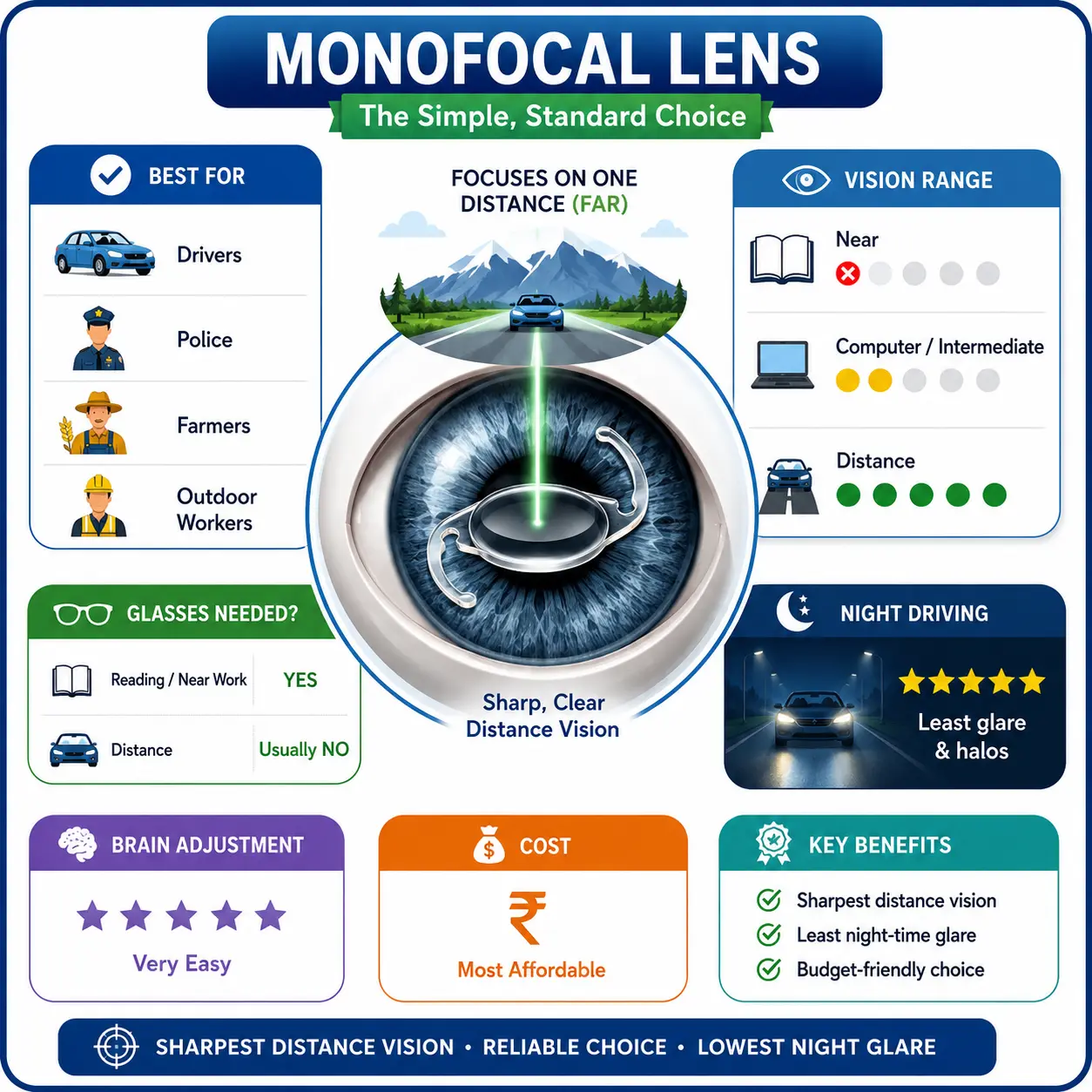
A monofocal lens is the most basic form of lens. “Mono” means one, and “focal” means focus, so a monofocul lens is built to focus on one distance only.
Think of it as a simple point-and-shoot camera that takes very sharp photos of distant objects.
What's good about it:
Your faraway vision becomes very sharp and clear. Door ki nazar ekdum saaf. You can see the road, the TV, people across the room, all crisp. At night, you get the least amount of glare or rings around streetlights. And it is the most budget-friendly, pocket-friendly choice of all.
The trade-off:
Because it focuses only at a distance, you will need reading glasses for close work, like reading a book, checking your phone, or looking at a menu. Paas ki cheezein padhne ke liye chashma lagana padega.
Getting used to it:
Very, very easy. Your brain accepts this lens almost immediately—no adjustment period.
Who is this lens best for?
If your work mainly involves looking at distant objects, a monofocal lens is often an excellent choice. I often recommend it to drivers, police officers, farmers, construction professionals, outdoor workers, teachers, and frequent travellers. You will still need reading glasses for close work, but in return, you get crisp distance vision with minimal glare and quick adaptation.
2. Multifocal and Trifocal Lenses (the all-in-one choice)
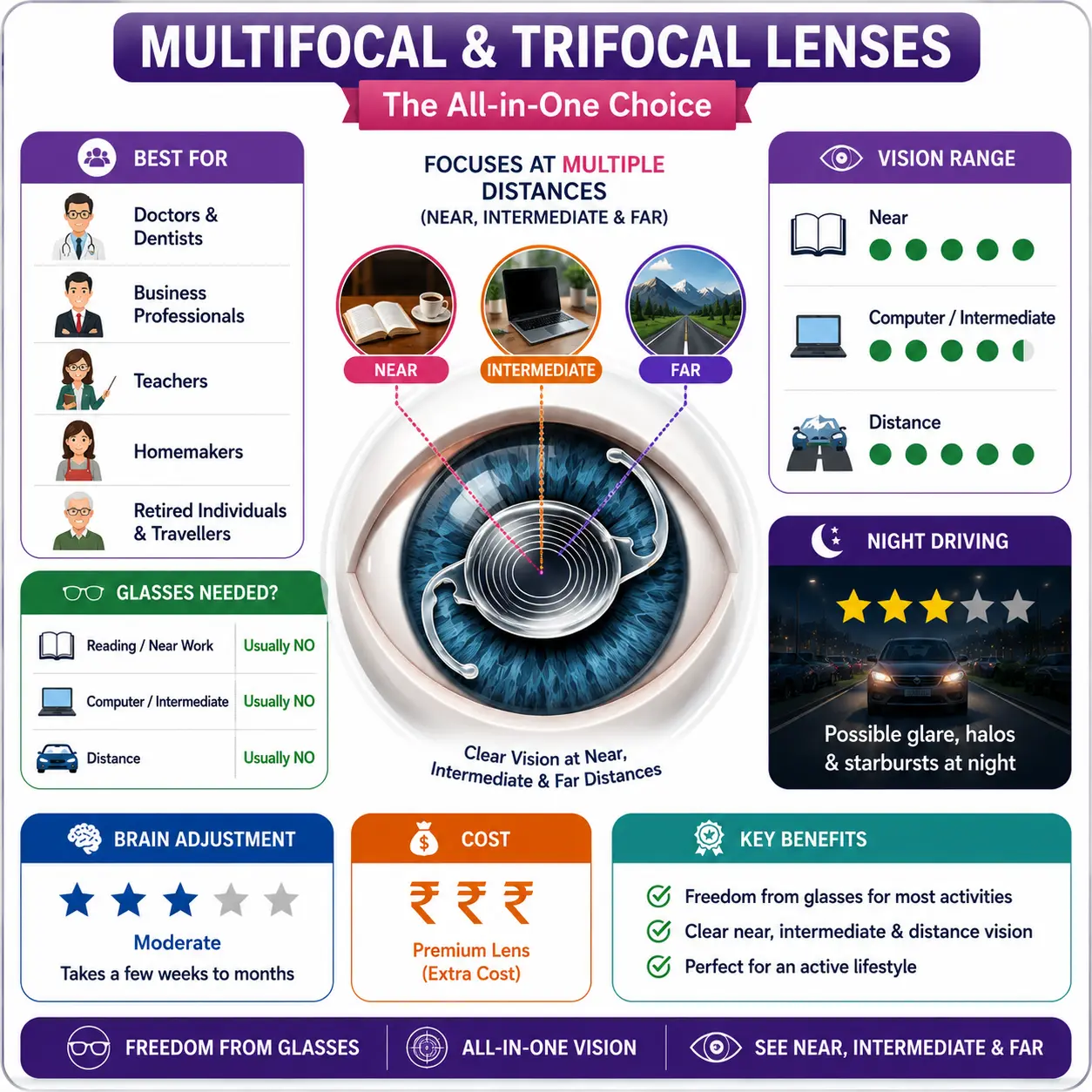
Now let’s go premium. “Multi” means many, “tri” means three. These lenses can focus at many distances at once: near, middle, and far.
If you have ever used progressive lenses in spectacles, you will understand it quickly. Just as progressive lenses adjust when you are seeing near or far, multifocal lenses let you see things clearly at any distance. These lenses have tiny rings that split the light into different zones so that you can see far, at arm’s length, and up close.
What's good about it:
You get freedom from glasses. Many people can read a book, work on a laptop, and drive, all without spectacles. If you want the type of cataract lens that gives you the most freedom from glasses, this is the one.
The trade-off:
Because the lens splits light into zones, at night you may see rings, starbursts, or glare around car headlights. Raat mein thoda glare aayega. Reading very tiny print in dim light can also be a little harder. You also pay extra out of pocket for this premium lens.
Getting used to it:
Your brain needs a few weeks, sometimes months, to learn how to use the different rings and ignore the glare. Doctors call this “neuroadaptation,” which just means “the brain slowly learning and adjusting.” Dimaag ko thoda time lagta hai adjust hone mein.
Who is this lens best for?
If your day requires you to see both far and near and you don’t want to use spectacles, multifocal lenses are a good option. I often recommend these lenses to doctors, dentists, business professionals, teachers, homemakers, retired individuals, and people who enjoy reading, travelling, or using digital devices throughout the day. However, if you frequently drive at night or are very sensitive to glare, you should discuss this carefully with your eye surgeon before choosing this lens.
3. Extended Depth of Focus (EDOF) Lens (the smooth middle choice)
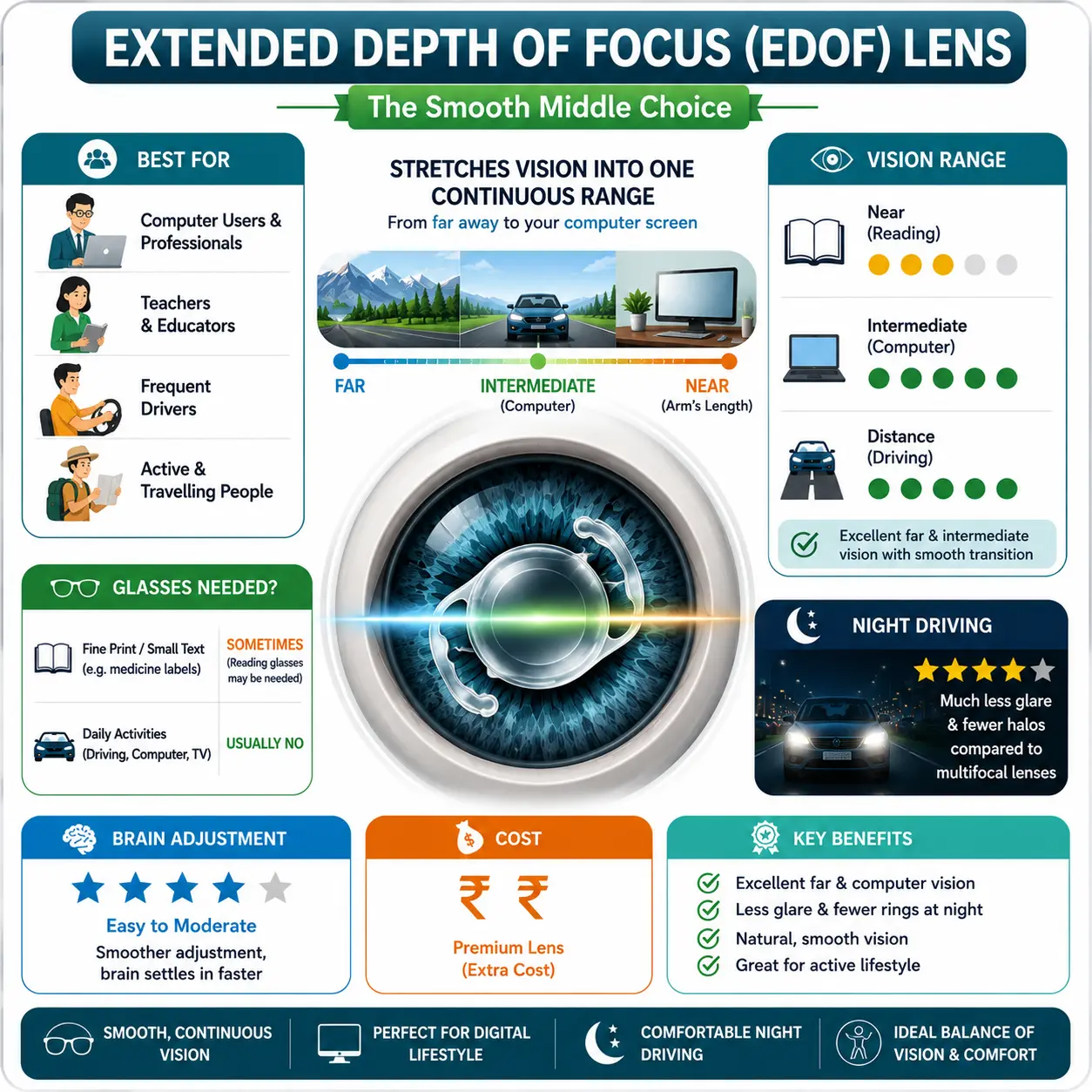
This lens stretches your clear vision like a rubber band, giving you a long, smooth range of vision.
A multifocal lens splits light into zones. An EDOF lens does not split it; it stretches it into a single continuous “runway” of clear vision, from far away to your computer screen. That’s why it is one of the most popular types of cataract lenses for active people today.
A multifocal lens is like having three different camera modes. One mode is for distant objects, another for intermediate distances, and another for close-up shots. Your brain quickly switches between these modes depending on what you’re looking at. This gives you a wide range of vision, but because the light is divided into different zones, you may notice glare or halos, especially at night. An EDOF lens, on the other hand, is like using a single camera mode that keeps almost everything, from far away to your computer screen, continuously in focus. Instead of jumping between different focus points, it creates one long, smooth range of clear vision. Since it doesn’t split light into separate zones, it usually causes much less glare and fewer halos. The only limitation is that very fine, close work, such as reading tiny medicine labels or threading a needle, may still require reading glasses. |
What's good about it:
Excellent in faraway and computer vision. And much less glare and fewer rings at night compared to multifocal lenses. Raat ko gaadi chalana aasaan ho jaata hai (driving at night is easier).
The trade-off:
It is not perfect for very tiny print. For small things like medicine labels or sewing, you may still need light reading glasses. And like other premium lenses, it costs extra.
Getting used to it:
Easy to medium. The adjustment feels much smoother than a multifocal lens, so your brain settles in faster.
Who is this lens best for? (EDOF Lens)
If you want clear distance and intermediate vision with fewer visual disturbances at night, an EDOF lens can be an excellent choice. I often recommend it to professionals who spend long hours on computers, such as software engineers, architects, teachers, business professionals, and office workers. It is also a good option for people who drive frequently, especially at night, because it usually causes less glare and fewer halos than multifocal lenses. If you are happy to wear light reading glasses occasionally for very small print, but want comfortable vision for most daily activities, an EDOF lens offers a good balance.
4. Toric Lens (the fix for a "football-shaped" eye)
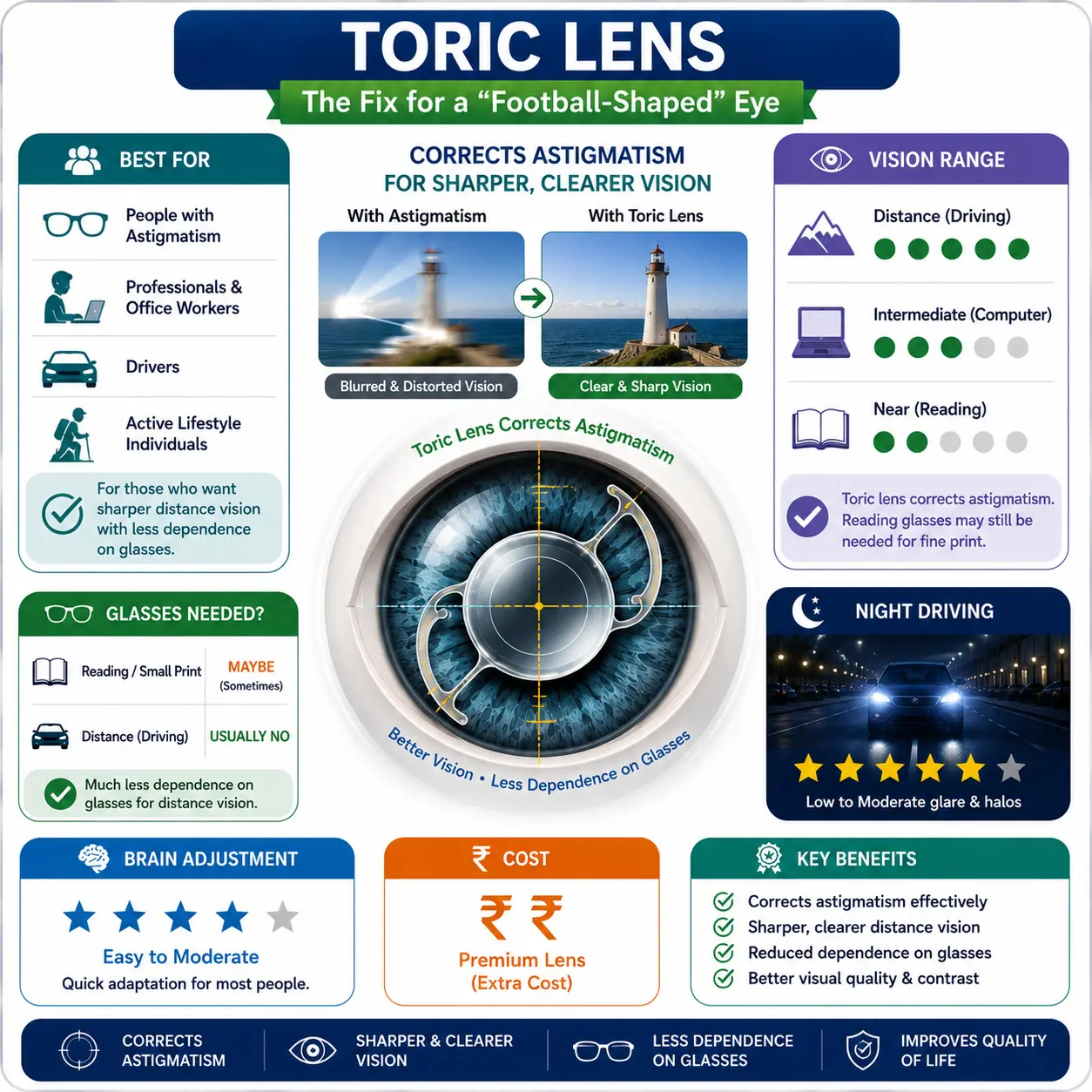
If you have visited any ophthalmology website, you might have come across the word ‘astigmatism’. Astigmatism means that the eye shape is not perfectly round. It is more like a rugby ball, long on one side. T
A Toric lens is made to match that shape exactly, like a tailored suit stitched to fit only your body.
What's good about it:
It permanently corrects astigmatism and gives you much sharper vision than a normal lens would. And here’s the nice part: you can get a Toric version of a monofocal, multifocal, or EDOF lens. It’s like an add-on.
The trade-off:
The doctor must place it in exactly the right position. If it shifts a little while your eye is healing, vision can go blurry again and may need a small adjustment. Fixing astigmatism also costs extra.
Who is this lens best for? (Toric Lens)
A toric lens is designed for people with astigmatism, in which the front surface of the eye is not perfectly round. If you have significant astigmatism before cataract surgery, a toric lens can correct it at the same time as your cataract, giving you much sharper vision without relying as much on cylindrical glasses.
I often recommend it to people who have always worn glasses with a cylindrical power, especially those who want the clearest possible distance vision after surgery. Depending on the type of toric lens chosen, you may still need glasses for reading or other close work, but your overall vision quality is usually much better than with a standard lens.
How to choose the right lens for YOU?
Aap soch rahe honge, “Dr Rajesh, mere liye sabse accha kya hai?” (You’re wondering, “Doctor, which is best for me?”). When choosing among lens types for cataract surgery, I always tell my patients to think about three simple things.
- Your daily life. What do you do all day? If you drive a lot at night and work on a computer, an EDOF lens is wonderful. If you love reading books and hate wearing glasses, a multifocal lens will make you very happy. If you just want sharp distance vision and don’t mind wearing reading glasses, a simple monofocal lens is perfect.
- Your budget. The standard monofocal lens is the most affordable choice. The premium lenses (multifocal, EDOF, Toric) cost extra out of pocket. Think about your wallet. And remember, even the standard lens gives you beautiful, clear vision. It is not a “lesser” choice; it is a very good choice.
- Your eye health. This is very important. If you have other eye problems such as dry eyes, glaucoma, or macular degeneration (weakness in the central part of the retina), premium lenses may not suit you and could even worsen your vision. In such cases, the simple monofocal lens is the safest and best option.
Quick comparison (in one glance)
- Monofocal: Sharp far vision, needs reading glasses, most affordable, easiest to adjust to.
- Multifocal / Trifocal: Far + middle + near; most freedom from glasses; some night glare; extra cost; takes time to adjust.
- EDOF: Smooth far + computer vision; less night glare; may need light reading glasses; extra cost.
- Toric: Fixes football-shaped eye (astigmatism); can be added to other lens types at extra cost.
A few quick questions patients always ask.
Does choosing a lens hurt? No. Choosing is just a chat with your doctor. The surgery itself is quick and mostly painless.
Will the lens ever need changing? No. The lens is made to stay in your eye for life.
Can I fully throw away my glasses? Sometimes yes, sometimes no. Premium lenses reduce glasses a lot, but a small pair of readers may still help for tiny print.
Which lens is “the best”? There is no single best lens for everyone. Among all the different types of lenses for cataract surgery, the best one is simply the lens that fits your life, your budget, and your eye health.
Conclusion
Getting your cloudy lens replaced is a beautiful second chance to see the world clearly and brightly again. So don’t rush, and don’t stress. Sit with your eye doctor, talk openly about your daily life and hobbies, and pick the lens that feels right for you.
Whatever you choose from these types of cataract lenses, one thing is certain: a brighter, clearer, more colourful world is waiting for you very soon.
Take good care of your eyes. Apni aankhon ka khayal rakhna!