
Is Femto Lasik and Contoura Vision Same?

MBBS, M.S. in Ophthalmology | 25+ years of Experience
Table of Contents
Quick Answer
No, Femto LASIK and Contoura Vision are not the same, but they are not rivals either. Femto LASIK describes how the corneal flap is made: with a femtosecond laser instead of a blade. Contoura Vision describes how the reshaping is planned: using a detailed map of your cornea’s surface, called topography. Many centres use both in one surgery, so the real question is which combination suits your eyes after a full check.
You finally decide to get rid of your glasses before your sister’s wedding. You call two eye centres. One quotes for “Femto LASIK”. The other suggests “Contoura Vision”. Both sound advanced, and the prices are different.
Now you are confused. Is Femto Lasik and Contoura Vision same? This is exactly what people want to know when they search Femto LASIK vs Contoura Vision.
We are the refractive surgery team at Suruchi Eye Hospital & Lasik Centre in Airoli, Navi Mumbai, and this mix-up comes up often during LASIK consultations. Let us explain what each term means, how they fit together, and how the right plan is chosen for your eyes.
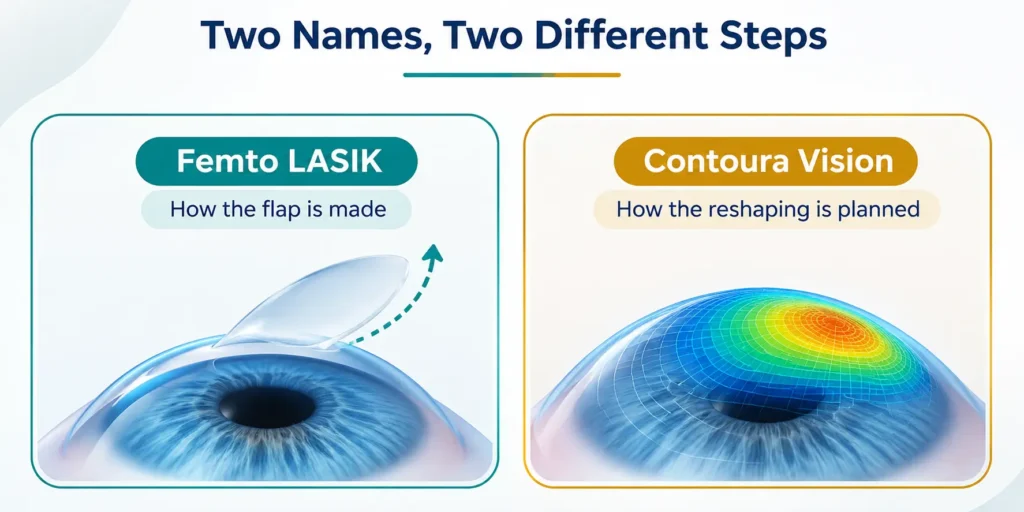
Femto LASIK is about how the flap is made. Contoura Vision is about how the reshaping is planned.
First, what happens in any LASIK surgery?
LASIK is a laser surgery that changes the shape of the cornea, the clear front window of the eye, so that light focuses better and you depend less on glasses or contact lenses.
It has two main steps. First, a thin flap is made on the top layer of the cornea and gently folded back. Then an excimer laser reshapes the tissue underneath, and the flap is placed back.
Femto LASIK and Contoura Vision each refer to one of these two steps. That is why comparing them directly is a bit like comparing apples with the plate they are served on.
So which step does each name describe?
What is Femto LASIK?
Femto LASIK, also called bladeless or all-laser LASIK. The LASIK in which the flap is made with a femtosecond laser instead of a mechanical blade device called a microkeratome.
The femtosecond laser uses extremely short pulses to separate the corneal layer precisely, so the flap’s thickness and size can be planned closely. After the flap is lifted, the excimer laser does the actual reshaping, just as in bladed LASIK.
Think of it like opening a steel cupboard. You can open it with a key or with a more precise electronic lock. How you open the door changes, but the work done inside the cupboard is the same.
A Cochrane review of 11 trials found no clear difference in final vision between flaps made by a femtosecond laser and flaps made by a microkeratome, though the evidence was of low certainty. The side effects differed a little: dry eye was reported more with the blade, and a type of flap inflammation (diffuse lamellar keratitis) more with the femtosecond laser.
If Femto LASIK is about the flap, what is Contoura Vision about?
What is Contoura Vision?
Contoura Vision is a type of topography-guided LASIK. The excimer laser treatment is planned from a detailed map of the front surface of your cornea, which can capture up to 22,000 elevation points.
In standard LASIK, the laser plan is built mainly from your glasses power, with a general allowance for the shape of the cornea. Contoura Vision adds your own corneal map, so the plan also tries to smooth small surface irregularities that glasses cannot correct.
Picture a tailor. Standard LASIK is like altering a good ready-made shirt to your size. Contoura Vision is closer to cutting the pattern from your own measurements. Both can fit well; one is more personalised.
The flap in Contoura Vision LASIK can still be made with a femtosecond laser. In fact, many centres combine the two: a femto flap, then a Contoura-planned reshaping.
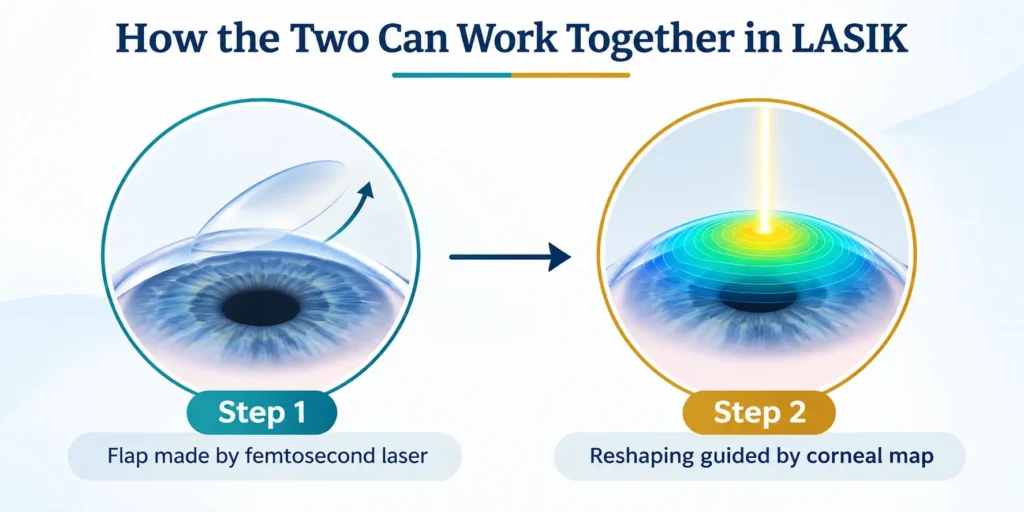
In many centres, a Contoura Vision treatment is done with a femtosecond laser flap. The two work at different steps.
Femto LASIK vs Contoura Vision: Side by Side
| Point | Femto LASIK | Contoura Vision |
|---|---|---|
| What the name describes | How the corneal flap is made | How the laser reshaping is planned |
| Main technology | Femtosecond laser for the flap | Corneal topography map guiding the excimer laser |
| Alternative it replaces | A blade device (microkeratome) | Standard plan based mainly on glasses power |
| Can they be combined? | Yes | Yes |
| What research shows | Similar final vision to bladed flaps; different side effect pattern | Good results; small gains in precision in some studies |
| Key requirement | Enough corneal thickness and a suitable eye | A good-quality corneal map, plus the same LASIK suitability |
“Doctor, so which one is better for me?”
Neither name is “better” on its own, because they answer different questions. The useful questions are: how will my flap be made, and how will my treatment be planned?
For the planning part, a 2021 review of 11 studies covering 1,425 eyes compared topography-guided LASIK with wavefront-optimised LASIK, a common standard plan. The share of eyes reaching 20/20 vision was not significantly different. Topography-guided treatment landed closer to the target power more often and may cause fewer optical aberrations, which can relate to glare and halos.
So topography guidance may add precision for some eyes, especially when the cornea has small irregularities. It does not mean everyone gets sharper vision than they would with a well-planned standard treatment.
Many families hear, “Contoura matlab sabse naya laser, wahi karwa lo.” A newer name is not a reason by itself. A treatment chosen to match your cornea is.
What decides that match?
Who may not be suitable for either?
Some eyes are not suitable for LASIK at all, whatever the flap method or laser plan.
- Thin or weak cornea. A cornea that is too thin, or shows signs of keratoconus (a condition in which the cornea bulges and thins), may need a different approach or no laser surgery.
- Unstable power. If your glasses number is still changing, it is usually wiser to wait until it settles.
- Significant dry eye. LASIK can make dryness worse for a while, so dry eye is treated or assessed first.
- Other eye or health conditions. Uncontrolled diabetes, some autoimmune conditions, pregnancy and certain eye diseases can affect healing or results.
- Poor-quality corneal maps. Contoura Vision depends on a reliable topography scan; a rough tear film or other surface problem can make the map less accurate.
When LASIK is not the right fit, there are other options such as surface laser treatments or implantable lenses, which the hospital can discuss after examining you.
A word on “bladeless”: ask what it means
The word “bladeless” is used loosely. Some centres use it for Femto LASIK, where a laser makes a flap. Others use it for no-flap surface treatments such as TransPRK, where the laser works directly on the surface and no flap is made at all.
TransPRK is a flapless laser vision correction procedure that uses an excimer laser to remove the corneal surface layer and reshape the cornea to correct refractive errors like myopia and astigmatism. Unlike LASIK, it does not involve creating a corneal flap.
These are different procedures, with different healing times and comfort in the first few days. So when you see “bladeless” on a quote, ask: is a flap made, and if so, how?
What we check when you come to the hospital?
At Suruchi Eye Hospital, we start with your daily life: screen time at work, driving at night, sports, and how you feel about glasses and lenses. Then we examine the eyes in detail.
- Your history. Age, how long your power has been stable, contact lens use, dryness, allergies, and general health.
- Glasses power. Measured carefully, often with drops that relax the focusing muscles.
- Corneal mapping and thickness. To check the shape and strength of the cornea and to look for early keratoconus.
- Tear film and eye surface. To find dry eye that should be treated first.
- Full eye check. Including eye pressure and the retina, since high myopia can be linked with retinal thinning.
After the tests, we explain whether you are suitable, which procedure fits your cornea, how the flap (if any) will be made, how the treatment will be planned, and what results and limits to expect.
After LASIK: what is normal and when to call us?
Usually normal in the first days or weeks
- Mild burning, grittiness or watering on the first day
- Slightly blurry or fluctuating vision that settles over days
- Glare, halos or starbursts around lights at night, which often reduce with time
- Dry feeling that needs lubricating drops
Contact the hospital soon if you notice
- Pain that gets worse instead of better
- A sudden drop in vision
- Increasing redness, light sensitivity or discharge
- Any injury or hard rub to the eye in the first weeks, since the flap can shift
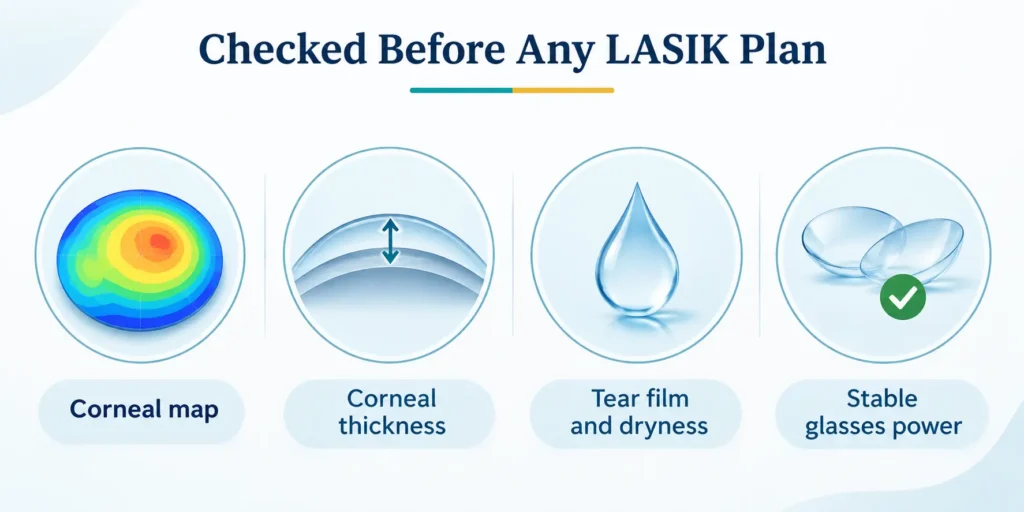
The same eligibility checks apply to Femto LASIK and Contoura Vision.
Frequently asked questions
Contoura Vision describes how the laser plan is made, not how the flap is made. It is often combined with a femtosecond laser flap, which is bladeless, but you should confirm the flap method for your own surgery.
No surgery can promise that. LASIK corrects your current power, but reading glasses may still be needed after about 40 because of natural ageing of the eye’s lens, and some people may need a small correction or touch-up later.
Numbing eye drops are used, so most people feel pressure rather than pain during the surgery. Some burning or watering is common for a few hours afterwards.
Many people return to desk work within a few days, but this varies. Your surgeon will advise you based on your healing and the type of procedure.
The machines, the planning software and what is included in the package all affect cost. Ask which flap method and which treatment plan are included, so you can compare like with like.
Two names, one decision
The Femto LASIK vs Contoura Vision comparison is less of a contest than it first appears. Femto describes the tool that opens the flap. Contoura describes the map that guides the reshaping. Both can be part of the same surgery, and both depend on the eye they are used on.
What matters most is whether your cornea is healthy and thick enough, whether your power is stable, and whether the plan matches your eyes and your daily life. A clear explanation of which flap method and which treatment plan you are being offered helps you make a calm, informed choice.
If you are thinking about laser vision correction, our team at Suruchi Eye Hospital & Lasik Centre in Airoli, Navi Mumbai, can examine your eyes, explain the options and answer your questions.
Disclaimer
This article is for general information only and does not replace a medical consultation. Treatment choices, including suitability for LASIK and the type of laser treatment, depend on an in-person eye examination by a qualified ophthalmologist.