
LASIK with the WaveLight EX500: Why the Machine and the Eye Surgeon Both Matter
Table of Contents
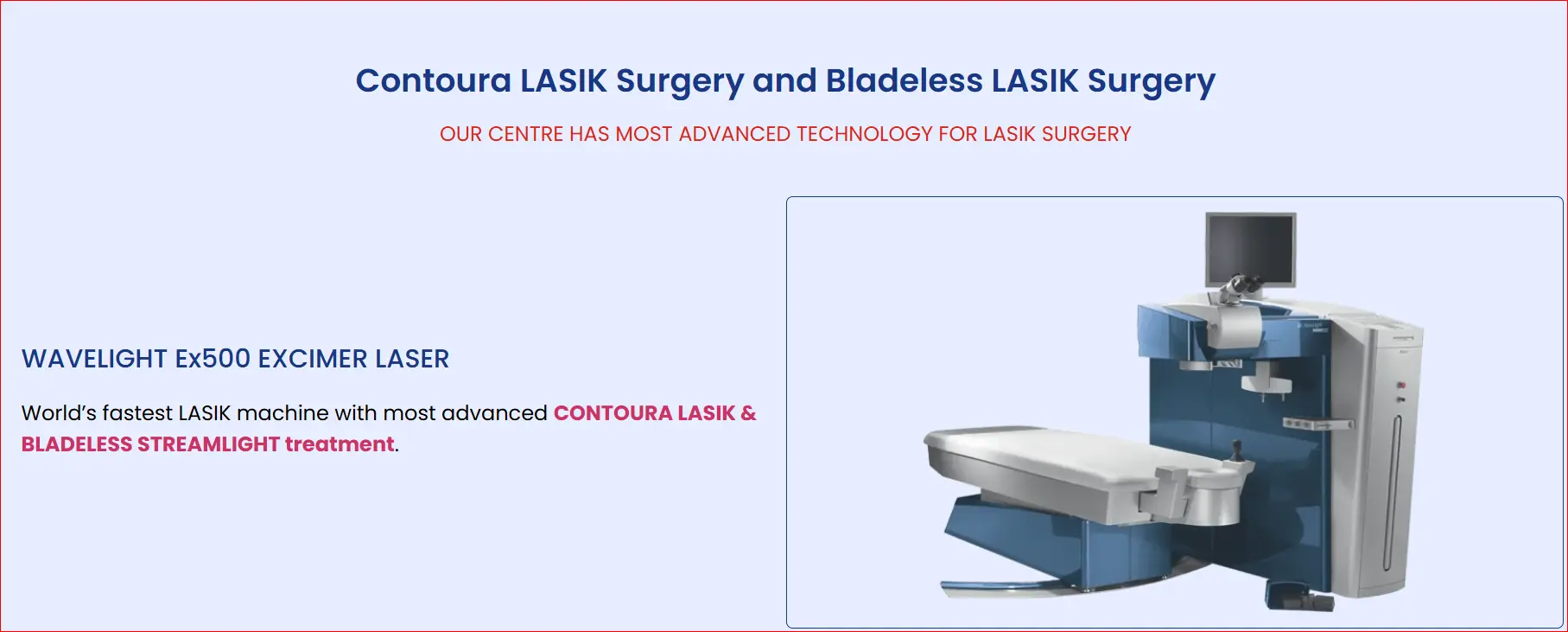
When you’re trusting someone with your eyes, you want two things working together perfectly: the world’s best technology and a surgeon who knows exactly how to use it. Here’s what makes the Alcon WaveLight EX500 stand apart and why the hands operating it matter just as much.
What This Means for You, the Patient
1. Your surgery is over before you can get nervous
The EX500 is one of the fastest LASIK lasers in the world. Correcting a typical prescription takes only about 1.4 seconds per number of power. For most patients, the actual laser treatment takes under 10 seconds per eye. You barely have time to think about it before it’s done. Ablation is so fast that you don’t have time to think even.
Speed isn’t just about comfort, though. The longer your cornea is exposed during surgery, the more it dries out, and a dry cornea can cause your prescription to be slightly off afterwards. A faster laser means a more predictable, more accurate result for your vision.
Ablation simply means removing a very thin layer of tissue using a laser, like gently “erasing” or “shaving off” microscopic amounts of material.
In LASIK terms:
Your cornea (the clear front window of your eye) has a certain shape. If that shape is too steep, too flat, or uneven, your vision becomes blurry, which is what glasses correct.
During LASIK, the laser performs ablation, which removes tiny, precise amounts of corneal tissue to reshape your cornea into the correct curve. Once the shape is corrected, light focuses properly on your retina, and you see clearly without glasses.
A simple analogy:
Imagine your cornea is a small piece of clay shaped like a dome. If the dome is too tall, you can’t see properly. The laser acts like an incredibly precise sculptor, gently scraping away just the right amount of clay, in just the right spots, to give the dome its perfect shape.
- No cutting, no heat damage: the laser vaporises tissue at a microscopic level
- Incredibly precise: measured in microns (1 micron = 1/1000th of a millimetre)
- Painless: the cornea is numbed with eye drops, and the procedure is over in seconds
So when you read “ablation speed: 1.4 seconds per diopter,” it simply means the laser takes about 1.4 seconds to remove enough tissue to correct one unit of your glasses power. Faster ablation = less time your eye is exposed = a safer, more accurate result.
2. Your cornea stays cool and safe
Most people don’t realise this, but every laser pulse generates a tiny amount of heat. Too much heat in one spot can cause scarring or healing issues. The EX500’s PerfectPulse Technology spaces out where each pulse lands, giving the cornea a moment to cool between hits. You walk away with a cleaner, healthier healing surface.
3. The laser follows your eye 1,000+ times per second
Your eyes make tiny micro-movements constantly; you can’t stop them even if you try. The EX500’s eye tracker checks your eye position 1,050 times every second and adjusts in just 2 milliseconds (faster than a blink). It even tracks how your pupil naturally shifts as light changes. So even if your eye moves during treatment, the laser stays exactly where it needs to be. Sub-millimetre precision, every single pulse.
4. Better night vision and fewer halos
Your eyes make tiny micro-movements constantly; you can’t stop them even if you try. The EX500’s eye tracker checks your eye position 1,050 times every second and adjusts in just 2 milliseconds (faster than a blink). It even tracks how your pupil naturally shifts as light changes. So even if your eye moves during treatment, the laser stays exactly where it needs to be. Sub-millimetre precision, every single pulse.
5. Safer for thin corneas and higher prescriptions
The EX500’s tissue-saving algorithms remove less corneal tissue for the same correction. That means people who were previously told “your corneas are too thin for LASIK” can often still be candidates. Higher prescriptions, too, can be treated more safely.
But Here's What the Machine Cannot Do Alone
A Formula 1 car is the fastest machine on the track, but put an untrained driver behind the wheel, and it becomes the most dangerous. The EX500 is exactly the same.
This laser gives a skilled surgeon the finest set of tools ever made. But the outcome of your LASIK depends on decisions only an experienced surgeon can make:
● Pre-operative judgement
Reading your corneal topography, measuring tear film, evaluating pupil size, and deciding whether LASIK, Contoura or TransPRK is the right choice for your eye. Many complications happen not in the OR but in the consultation room, when the wrong patient is chosen for the wrong procedure.
● Customising your treatment plan
Two patients with the same -3.00 prescription may need very different ablation profiles based on the shape of their cornea, their lifestyle, and their visual demands. The surgeon decides this, not the machine.
● Surgical technique
Centring the treatment, managing the flap, handling any micro-bleeding, and reacting calmly if your eye behaves unexpectedly. Years of practice show in seconds that you’ll never see.
● Post-operative care
Catching dry eye, inflammation, or healing irregularities early. A good surgeon stays involved long after you leave the operating room.
The EX500 makes a great surgeon’s work even more precise. It does not turn an average surgeon into a great one. Here, Dr Rajesh Kapoor’s experience of more than two decades comes into play. As a specialist in Robotic Cataract Microincision Surgery (MICS) and Bladeless LASIK with Contoura technology, Dr. Kapoor serves patients in Navi Mumbai, Airoli, Mulund, Thane, Mumbai, and beyond. He actively participates in conferences and keeps abreast of the latest developments in ophthalmology.
What You Should Ask Before Your LASIK
When choosing where to have your surgery, don’t just ask “Which machine do you use?” Also ask:
- How many LASIK surgeries has the surgeon personally performed?
- Will the same surgeon do my pre-op, surgery, and follow-ups?
- What is the centre’s complication rate, and how are problems handled?
- Are detailed corneal scans (topography, pachymetry, aberrometry) done before deciding on the procedure?
The WaveLight EX500 represents the best of what technology can offer for your vision. Combined with a surgeon who has invested years mastering it, you get the safest, most precise, and most predictable LASIK experience available today.
Your eyes get one chance at this surgery. They deserve both.