
Is Cataract and LASIK Surgery the Same? Understanding the Difference

MBBS, M.S. in Ophthalmology | 25+ years of Experience
Table of Contents
Key Takeaways
- No, cataract surgery and LASIK are not the same.
- LASIK reshapes the cornea to correct refractive errors such as myopia, hyperopia and astigmatism.
- Cataract surgery removes the cloudy natural lens inside the eye and replaces it with an artificial intraocular lens.
- LASIK does not remove cataracts because a cataract affects the natural lens, not the cornea.
- Cataract surgery is not simply another form of LASIK, even when laser technology is used during the procedure.
- If your vision is blurry, the right procedure depends on why your vision has become blurry, not simply on your glasses number.
I get asked about LASIK and cataract surgery in very different situations.
Someone who has worn glasses for years may come to me and say, “I am tired of depending on my glasses. Can I get LASIK?”
Another person may say, “My glasses are no longer giving me the vision they used to. Do I need a stronger number?”
Both are talking about their vision. But the answer can be completely different.
This is because LASIK and cataract surgery do not treat the same part of the eye.
When I assess someone for LASIK, I am looking at the cornea and the way the eye is focusing light. LASIK reshapes the cornea to correct refractive errors such as myopia, hyperopia and astigmatism.
With cataracts, the issue is somewhere else. The natural lens inside the eye has become cloudy. When that starts affecting vision, cataract surgery involves removing that cloudy lens and replacing it with an artificial intraocular lens.
So when someone asks me, “Is cataract and LASIK surgery the same?”, my answer is simple:
No. LASIK changes the cornea. Cataract surgery replaces the natural lens.
That is the starting point for understanding everything else about the two procedures.
Let us look at them one by one.
What is LASIK surgery?
LASIK is a type of refractive eye surgery.
The cornea is the clear surface at the front of your eye. Along with the natural lens inside the eye, it helps focus light onto the retina so that you can see clearly.
When the shape of the cornea or the eye causes light to focus incorrectly, you can develop a refractive error. Common examples include myopia, hyperopia and astigmatism.
LASIK surgery works by changing the shape of the cornea.
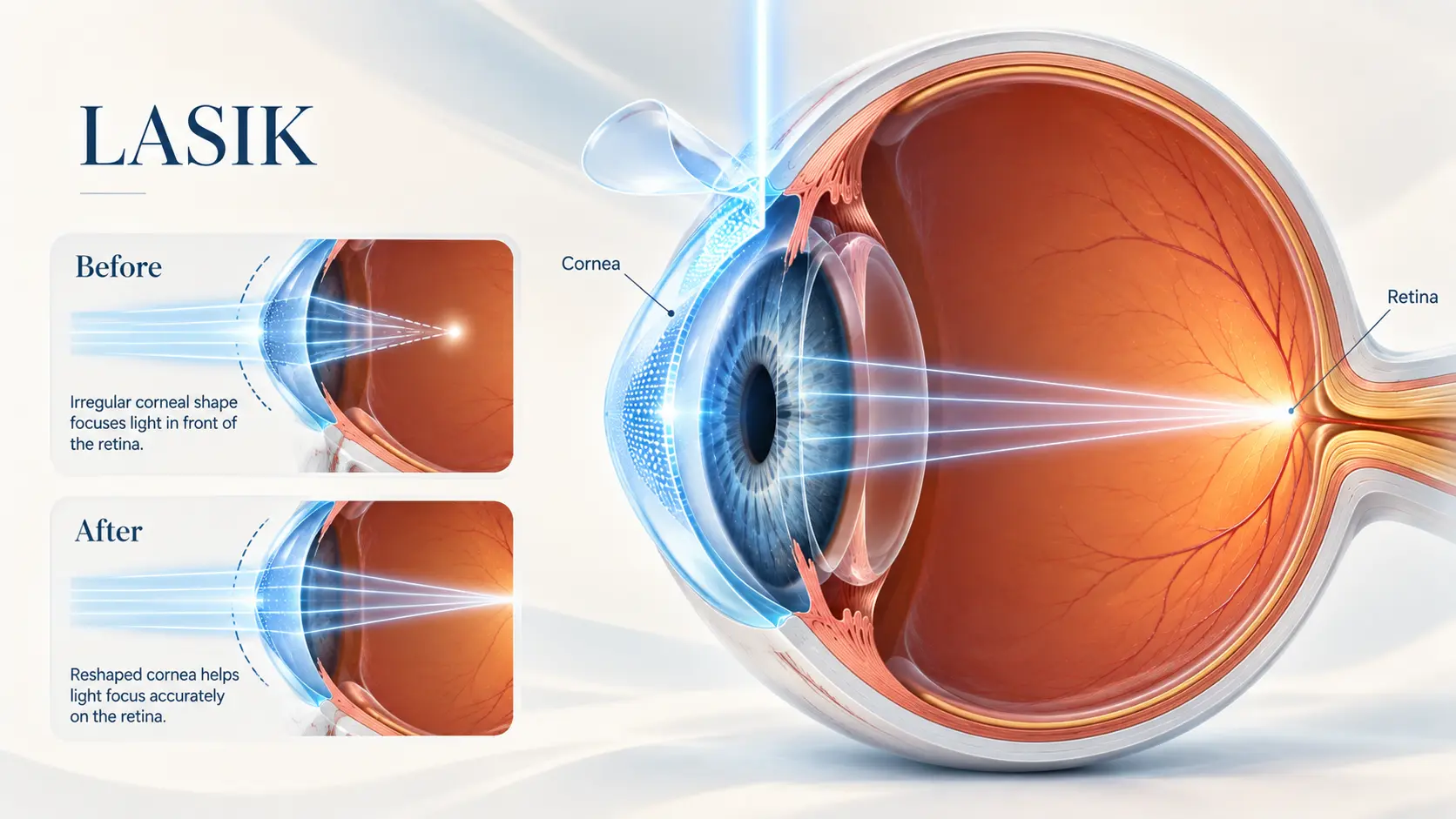
A laser removes a precisely calculated amount of corneal tissue so that the cornea can focus light more accurately. The aim is generally to reduce dependence on glasses or contact lenses.
Think of the cornea as part of your eye’s focusing system.
If that focusing system is slightly off, the image reaching the retina may not be sharp. LASIK changes the corneal shape to address that problem.
So who may be considered for LASIK?
Not everyone with glasses is automatically a LASIK candidate.
Before recommending LASIK, we need to look at the overall health of the eye. Depending on the individual, this can include assessing the cornea, checking the stability of the prescription and looking for conditions that could make LASIK in Navi Mumbai.
Dry eye, certain corneal conditions, an unstable prescription and other eye or health factors may determine if you’re a good candidate for LASIK.
That is why a proper LASIK evaluation is much more than asking, “What is your glasses number?”
What is cataract surgery?
Now let us look at cataract surgery.
Inside your eye is a natural lens. It is normally clear and helps focus light.
A cataract develops when this natural lens becomes cloudy.
You may notice that things look hazy or less sharp. Some people notice more glare while driving at night. Colours may appear less clear, or changing glasses may no longer give the same improvement as before.
The important point is that the problem is now with the natural lens inside the eye.
Cataract surgery addresses that lens.
During cataract surgery, the cloudy natural lens is removed and replaced with an artificial lens called an intraocular lens, or IOL.
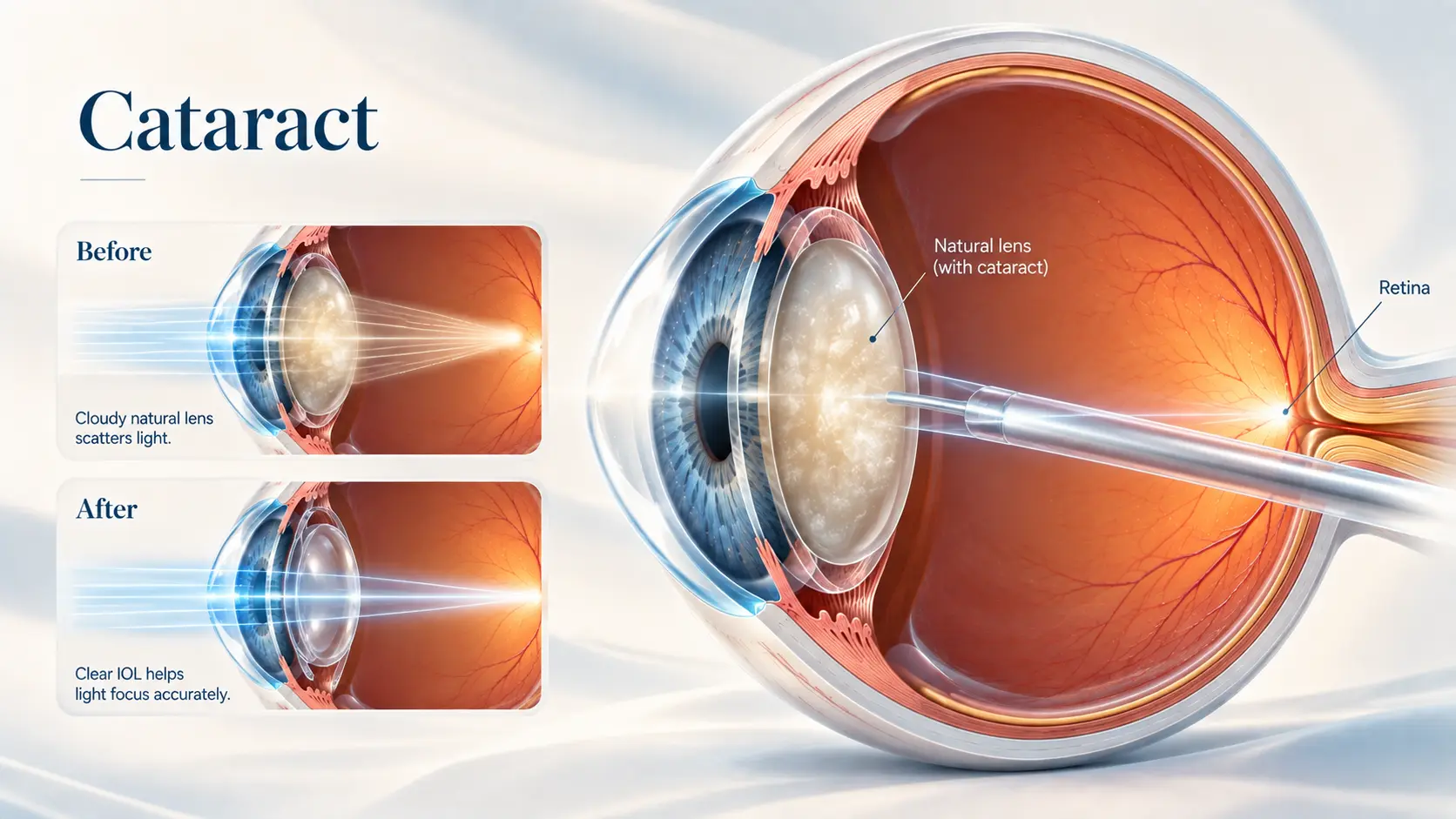
This is why cataract surgery and LASIK are fundamentally different.
With LASIK, we reshape the cornea.
With cataract surgery, we remove the cloudy natural lens and place an artificial lens inside the eye.
So, how is LASIK different from cataract surgery?
The easiest way to understand the difference is to look at which part of the eye is being treated.
| LASIK | Cataract Surgery | |
|---|---|---|
| Main problem treated | Refractive errors | Cataract |
| Part treated | Cornea | Natural lens |
| What happens | Cornea is reshaped | Cloudy natural lens is removed |
| What replaces it? | Nothing | An artificial intraocular lens |
| Main purpose | Reduce dependence on glasses or contact lenses | Improve vision affected by a cataract |
| Can it remove a cataract? | No | Yes |
LASIK is therefore a corneal procedure used for refractive correction.
Cataract surgery is a lens replacement procedure used to treat a cloudy natural lens.
This distinction becomes much easier when you stop thinking about the word “laser” and start thinking about the part of the eye being treated.
But if cataract surgery can use a laser, isn't it basically LASIK?
No.
This is probably where much of the confusion comes from.
You may hear about laser-assisted cataract surgery, while LASIK is also called laser eye surgery. But the two procedures still have completely different purposes.
In laser-assisted cataract surgery, a femtosecond laser may be used for certain steps, such as creating incisions or helping with the opening in the lens capsule and softening the cataract. The cloudy lens is then removed and an artificial intraocular lens is placed inside the eye.
LASIK, on the other hand, uses a laser to reshape the cornea.
So:
LASIK = reshape the cornea.
Cataract surgery = remove the cloudy natural lens and replace it with an artificial lens.
The technology may overlap in some cases, but the surgery itself is not the same.
Can LASIK remove a cataract?
No.
This is an important distinction.
A cataract is a clouding of the natural lens inside your eye. LASIK works on the cornea, which is at the front of the eye.
So if the cloudy lens is causing your vision problem, reshaping the cornea will not remove that cloudy lens.
This is also why LASIK should not be considered a substitute for cataract surgery when a cataract is the cause of the visual problem.
If someone has both a refractive error and a cataract, the situation needs a proper eye examination. We have to determine which changes are affecting vision and what treatment is appropriate.
How should I know whether I need LASIK or cataract surgery?
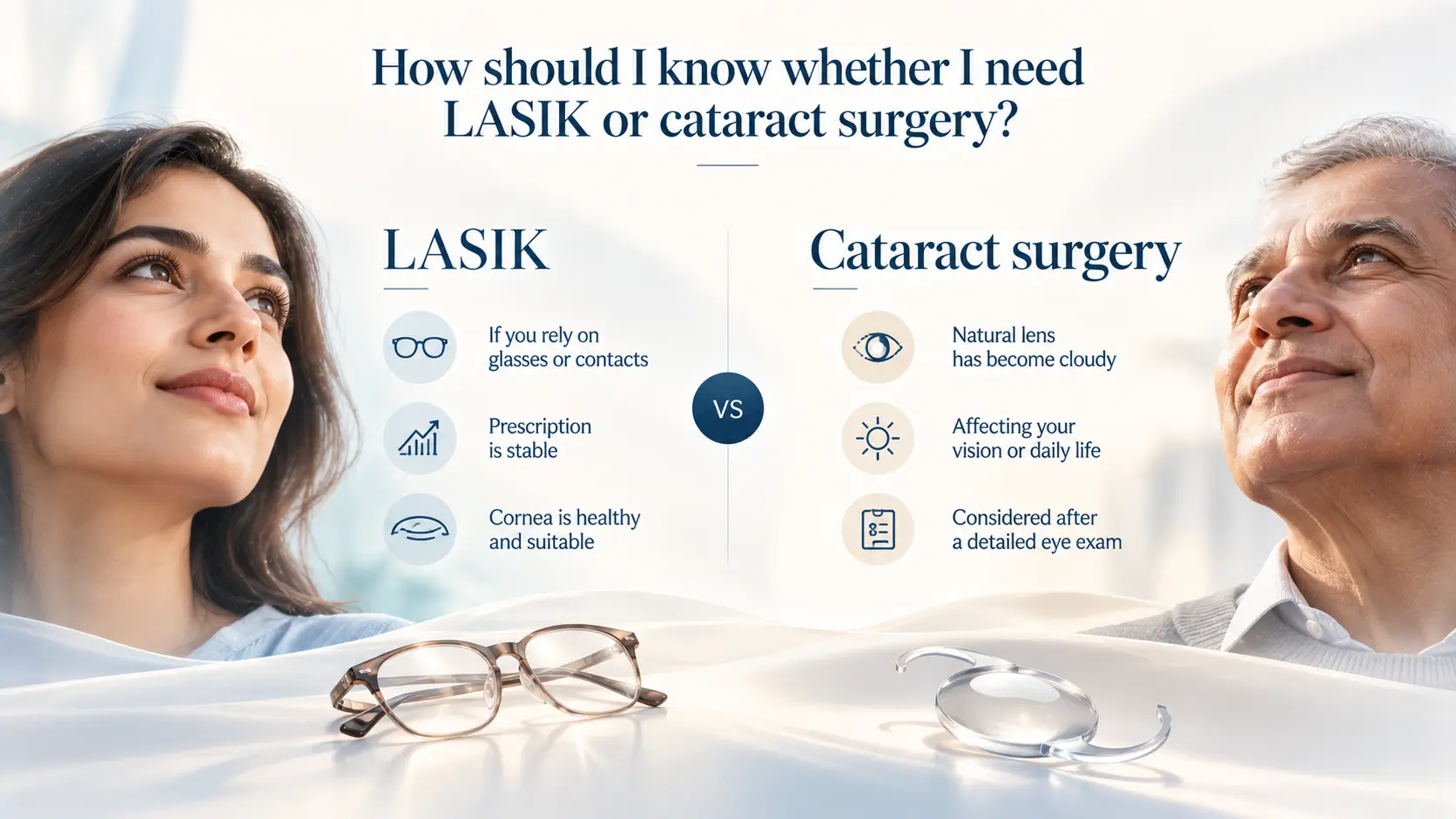
This is where an eye examination matters more than an online comparison.
If you are younger and have been dependent on glasses or contact lenses because of myopia, hyperopia or astigmatism, LASIK may be one of the options we assess.
If your natural lens has become cloudy and that cataract is affecting your vision or daily activities, cataract surgery may be considered. In adults, surgery does not always have to happen immediately. Before getting cataract surgery, it is important to understand when surgery is needed, what the procedure involves and what you can expect afterwards. It is generally considered when the cataract starts affecting your everyday life and quality of vision.
During an evaluation, we may need to consider:
- Your current glasses prescription
- Whether your prescription has remained stable
- The shape and health of your cornea
- The thickness and other characteristics of the cornea
- The condition of your natural lens
- The health of your retina and optic nerve
- Dry eye or other eye conditions
- Your usual visual needs
- Whether your vision problem is actually coming from a cataract or another eye condition
So, sirf chashme ka number dekhkar surgery decide nahi hoti.
The diagnosis comes first.
The procedure comes after that.
What if I have had LASIK before and now have cataracts?
You can still develop cataracts after having LASIK. Cataract surgery after LASIK is possible, and there is no contradiction here.
LASIK changes the shape of your cornea. Your natural lens remains inside your eye.
That means a person who had LASIK years ago can later develop a cataract.
If you have had previous LASIK and now need cataract surgery, tell your ophthalmologist about the previous procedure. Your previous refractive surgery and old eye measurements can be relevant when planning the cataract procedure and calculating the artificial lens power.
This is one reason I always encourage patients to keep their old eye and surgery records where possible.
Your eye history stays useful even after several years have passed.
Can someone with a cataract have LASIK instead?
If the cataract is what is causing the vision problem, LASIK will not remove it.
However, the situation is not always as simple as “cataract or LASIK.”
A person may have a refractive error and early cataract changes at the same time.
For example, someone may have worn glasses for years and then notice that even the new prescription does not make vision as clear as it used to be.
That is when we need to look beyond the prescription.
The natural lens, cornea, retina and other parts of the eye all contribute to vision. A change in any of these can affect how clearly you see.
The aim of an eye examination is therefore not to find a reason to recommend a particular surgery.
It is to find the reason for the visual problem.
When should you get your eyes checked?
Do not wait for vision to become severely blurred before getting it checked.
If you notice persistent changes in clarity, increasing glare, difficulty driving at night, frequent changes in your prescription or difficulty performing everyday tasks, an eye examination can help identify the cause.
But some symptoms need more urgent attention.
See an eye doctor urgently if you notice:
- Sudden loss of vision
- A sudden increase in floaters
- Flashes of light
- A curtain or shadow coming across your vision
- A sudden and significant change in eyesight
These symptoms can sometimes indicate a retinal problem that requires prompt assessment. They should not simply be assumed to be a cataract or a glasses problem.
A Final Thought From Me
I do not think anyone should walk into an eye clinic already convinced that they need LASIK or cataract surgery.
Come with the problem you are experiencing.
Tell me what has changed. Tell me whether you are struggling with reading, driving, distance vision, glare or your glasses. Then let the examination tell us what is happening inside the eye.
Sometimes the answer may be LASIK.
Sometimes it may be cataract surgery.
And sometimes, you may not need surgery at all.
The right starting point is not the name of the procedure. It is understanding your eyes.
If you are in Airoli or Navi Mumbai and are experiencing a change in vision or want to understand whether LASIK or cataract treatment is appropriate for you, you can meet me, Dr. Rajesh Kapoor, at Suruchi Eye Hospital for an eye evaluation. We’re located in Sector 4, Airoli, Navi Mumbai.