
MICS Cataract Surgery vs Phacoemulsification: What Is the Real Difference in Cataract Surgery?

MBBS, M.S. in Ophthalmology | 25+ years of Experience
Table of Contents
Quick Answer
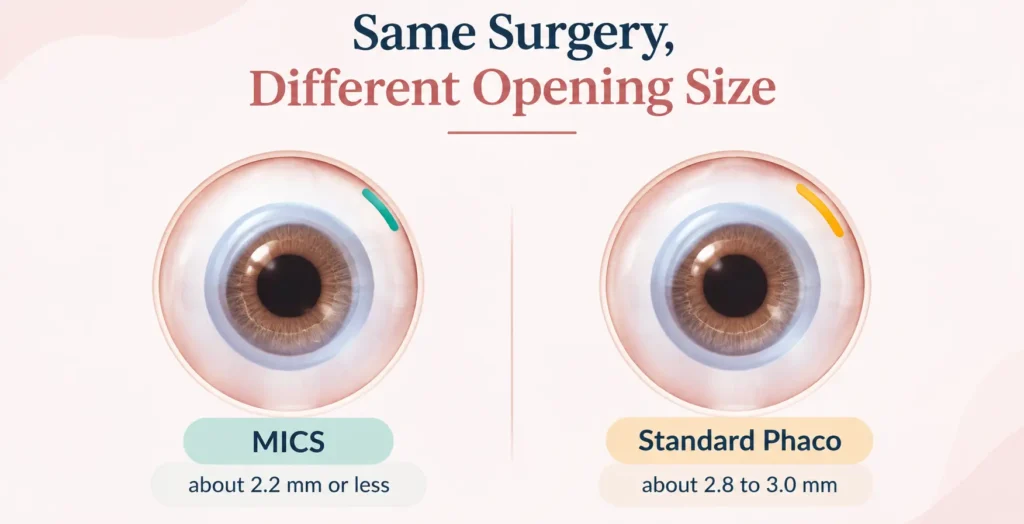
MICS (micro-incision cataract surgery) is not a separate operation from phacoemulsification. It is phaco done through a smaller opening, usually about 2.2 mm or less, while standard phaco uses roughly 2.8 to 3.0 mm. Research suggests the smaller opening may change the shape of the cornea slightly less, but the difference is small and final vision is largely similar. For most people, the right lens, careful eye measurements and the health of the eye matter more than a fraction of a millimetre.
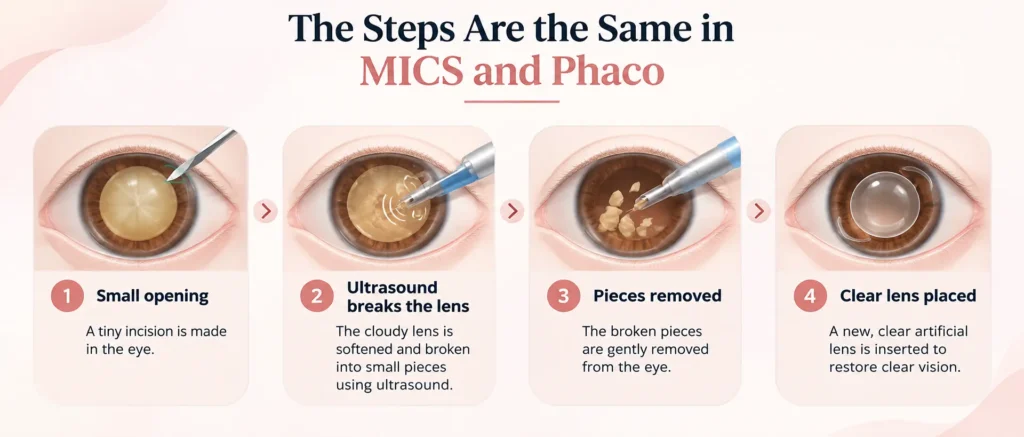
MICS and standard phaco follow the same steps. The main difference is the width of the opening.
Your father has finally agreed to get his cataract operated on. Now the family WhatsApp group is busy.
One cousin says, “Go for MICS, it is the latest.” An uncle says phaco is enough; his own surgery went fine. The hospital estimate shows both words, and the packages are not priced the same.
So you sit with the report and wonder: what is the real difference? This is the question behind most searches for MICS Cataract Surgery vs phacoemulsification. Is one truly better for the eyes, or is it a newer name for the same thing?
At Suruchi Eye Hospital & Lasik Centre in Airoli, families often bring this exact question to our OPD. Let us walk you through what each term means, what research actually shows, and how the choice is made for your eyes.
What is phacoemulsification (phaco), in simple words?
Phacoemulsification, or “phaco”, is the most common of the types of cataract surgery used today. The surgeon makes a small opening at the edge of the cornea, the clear front window of the eye.
A thin probe uses ultrasound energy to break the cloudy natural lens into tiny pieces, which are gently sucked out. A folded artificial lens, called an intraocular lens or IOL, is then placed where the natural lens sat. In most eyes, the opening seals on its own, so stitches are usually not needed.
If phaco already works through a small opening, what does MICS add?
So what is MICS, and how is it different from phaco?
MICS stands for micro-incision cataract surgery. It follows the same steps as phaco, through a smaller opening of about 2.2 mm or less. This needs finer instruments, a phaco machine set up for micro-incision work, and a lens that can fold or roll tightly enough to pass through.
Think of filling a narrow-mouth water bottle compared with a wide steel dabba. The job is the same. The narrow mouth needs the right tools and a little more care, and not everything will fit through it.
So MICS is a refinement of phaco, not a different operation.
Phacoemulsification vs MICS: a side-by-side look
| Point | MICS (micro-incision) | Standard phaco |
|---|---|---|
| What it is | Phaco through a smaller opening | Ultrasound removal of the cataract through a small opening |
| Usual opening size | About 2.2 mm or less | About 2.8 to 3.0 mm |
| Stitches | Usually not needed | Usually not needed |
| Effect on corneal shape (astigmatism) | May be slightly less; small, uncertain difference in research | Slightly more change, often minor |
| Final vision | Largely similar in research | Largely similar in research |
| Lens options | Lens must pass through the smaller opening | Wider range of lens designs fit |
| Who decides | Your eye surgeon, after a full eye check | Your eye surgeon, after a full eye check |
“Doctor, is the smaller cut really better for my eyes?”
A smaller cut can be a little gentler on the cornea, but the gain is smaller than many advertisements suggest.
A Cochrane review pooled 26 randomised trials comparing 2.2 mm micro-incision phaco with standard phaco of about 3.0 mm. The smaller opening may cause slightly less surgically induced astigmatism, about 0.2 dioptre, but the reviewers rated this evidence as uncertain. Final vision and the health of the cornea’s inner cell layer showed little or no difference in most comparisons.
A 0.2 dioptre change is small, though it may matter more with premium lenses that aim for very precise focus. So we do not promise anyone “better eyesight” just because of MICS.
Then why do people say recovery is faster?
Does MICS mean faster recovery or no stitches?
Both MICS Cataract Surgery and standard phaco are usually stitchless, and recovery in both is often quick for routine cataracts.
The opening is made as a small slanted tunnel. Like the flap of an envelope that presses shut, the pressure inside the eye pushes the tunnel closed. A smaller tunnel may seal a little more easily.
How fast you see clearly depends more on the cataract’s density, the health of the cornea and retina, conditions like diabetes or glaucoma, and how well drops and follow-ups are kept. The US National Eye Institute notes that most people are fully healed about 8 weeks after surgery, and both eyes are done on separate days, usually about a month apart.
Is MICS the same as laser surgery like Femto LASIK or Contoura Vision?
No. MICS treats a cataract inside the eye. Femto LASIK and Contoura Vision are laser procedures on the cornea that correct glasses power, and they do not remove a cataract.
Think of the eye like a camera. LASIK polishes the outer glass to change its focus, while cataract surgery replaces the fogged lens inside.
Many families hear, “Laser wala operation karwa lo, jaldi theek ho jaata hai.” Lasers are used for some steps in certain cataract surgeries, but the American Academy of Ophthalmology states that studies so far have not shown laser-assisted cataract surgery to be superior to standard phaco.
If you are planning cataract surgery after LASIK, Femto LASIK, Contoura Vision or any other laser vision correction, tell your cataract team. Earlier corneal laser work makes the lens power calculation more difficult, so old records of your glasses power and laser surgery help.
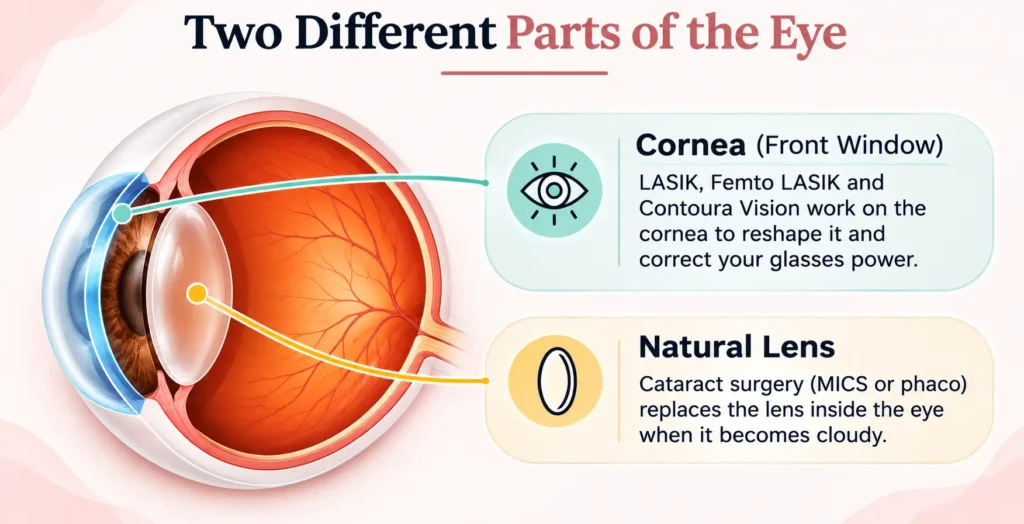
LASIK, Femto LASIK and Contoura Vision work on the cornea. Cataract surgery replaces the lens inside the eye.
Phacoemulsification vs MICS: Which one will suit my eyes?
The choice is made after examining your eye, not from a brochure. A few things guide it:
- Density of the cataract. Very hard cataracts may need more ultrasound energy or, in some eyes, manual small incision cataract surgery.
- Health of the cornea. A weak inner corneal layer needs extra protection, whatever the incision size.
- Eye structure. A pupil that does not open well, a shallow front chamber or weak lens support can change the approach.
- The lens you choose. Monofocal, toric and multifocal or EDOF lenses come in many designs, and some need a slightly larger opening.
- Other eye conditions. Diabetic retina changes, glaucoma or previous eye surgery shape the plan.
Patients often ask, “Doctor, should I take the costlier imported lens?” The honest answer is that the right lens is the one that fits your eye measurements and how you use your eyes, not the costliest one.
What we check when you come to the hospital?
We start with what bothers you, such as night driving, reading or glare, and then examine the eye fully.
- History. Diabetes, blood pressure, blood thinners, previous eye surgery or laser treatment, and your daily visual needs.
- Vision and eye pressure. To see how much the cataract affects you and to check for glaucoma.
- Slit lamp and retina check. To see the cataract’s type and density, and the retina behind it.
- Lens measurements. Optical biometry (IOL Master 700) to measure the eye and calculate lens power.
- Corneal health. A specular microscope to check the inner corneal cells.
Then we explain whether surgery is needed now and which technique and lens suit your eye, so you can decide with full information.
Is it okay to wait before cataract surgery?
Often, yes. If the cataract is mild and not affecting daily work, waiting with regular check-ups is reasonable for many people. The US National Eye Institute notes that you do not need to rush into cataract surgery, and that the decision should weigh its risks and benefits for you.
What drops, diet or home remedies cannot do is clear a cataract. Once it affects driving, reading, work or safety, surgery is the only treatment. The stage of the cataract guides timing. A very mature cataract, or one that raises eye pressure, may need earlier surgery.
After surgery: what is normal and when to call us?
Usually normal in the first days or weeks
- Mild grittiness, itching, watering or redness
- Blurry or hazy vision at first, slowly clearing
- Colours looking brighter or whiter than before
- Some glare or halos around lights, which often settle
Contact the hospital soon if you notice
- Pain that is getting worse instead of better
- Vision that suddenly drops after first improving
- Increasing redness or sticky discharge
- New flashes, a shower of floaters, or a curtain or shadow over part of your vision
- Blurring that returns months or years later, which can be a “secondary cataract” (posterior capsule opacification) and is treatable
Frequently asked questions
Not automatically. MICS is phaco through a smaller opening, and research shows only a small, uncertain gain in reduced astigmatism, with similar final vision. The right choice is the one that suits your eye and planned lens.
Cataract surgery, whether MICS or standard phaco, is usually done with numbing eye drops while you stay awake. Most people feel pressure or see lights rather than pain. Mild discomfort for a day or two is common.
That depends on the lens, not the incision size. With a standard monofocal lens, most people still need reading glasses. Toric, multifocal or EDOF lenses can reduce dependence on glasses for some people, but no lens can promise a glasses-free life.
No. They reshape the cornea to correct glasses power but cannot remove a cloudy lens. A cataract needs cataract surgery.
Packages differ mainly because of the instruments and the lens included. Ask what each package includes so you compare like with like.
The cut is small; the decision is bigger
Comparing MICS Cataract Surgery vs phacoemulsification really means comparing two versions of the same well-tested operation. Both remove the cloudy lens with ultrasound, both place a clear artificial lens, and both usually heal without stitches. One simply uses a smaller doorway.
What shapes your vision afterwards goes beyond the size of the cut: accurate measurements, a lens that matches your eyes and lifestyle, a healthy cornea and retina, and careful follow-up.
If someone in your family is weighing cataract surgery, an unhurried eye check is a good place to start. Our team at Suruchi Eye Hospital & Lasik Centre in Airoli, Navi Mumbai, can examine the eye, explain the options and answer your questions.
Disclaimer
This article is for general information only and does not replace a medical consultation. Treatment choices, including the type of cataract surgery and lens, depend on an in-person eye examination by a qualified ophthalmologist.